

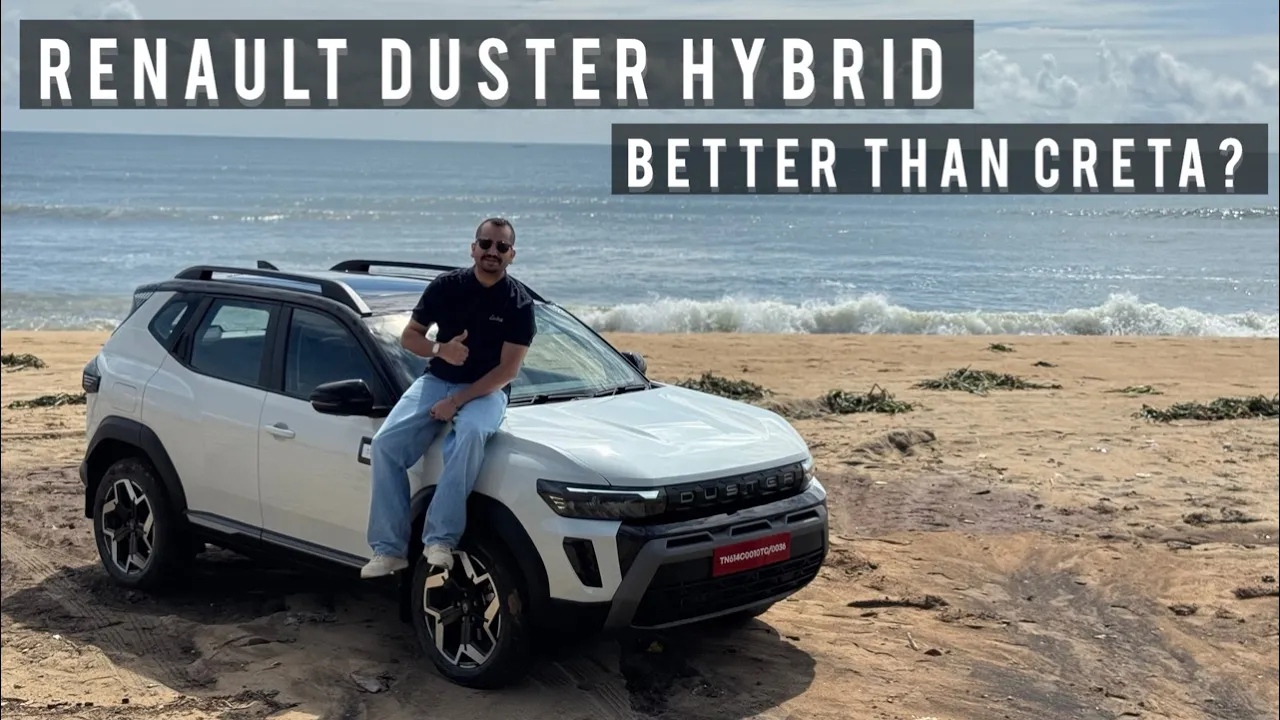
This is the first time the Renault Duster gets a strong hybrid option in India, and it could be one of the most significant additions to the model range. After driving both petrol versions earlier, I got behind the wheel of the hybrid for an extended drive around Chennai and along the East Coast Road towards Pondicherry. What became evident rather quickly was that this isn’t simply a Duster developed to deliver better fuel efficiency. The hybrid also gets a revised suspension setup, and the combination makes it feel like a more mature and complete product.
A familiar Duster, with subtle hybrid additions
The hybrid retains the bold, upright styling of the new-generation Duster, with its chunky black cladding, prominent skid-plate treatment and full-LED headlamps. The hybrid-specific changes are relatively subtle, though. You get illuminated Duster lettering on the front grille, dual-tone alloy wheels, E-Tech Hybrid badging on the front doors and rear, along with slightly different lower-body cladding.
The hybrid does miss out on a few features, though. There is no ADAS hardware, no front camera and no 360-degree camera system. You also don’t get fog lamps on the variant showcased. These omissions are surprising considering the positioning of the hybrid, especially for buyers who want the latest technology and are willing to pay for it.
A premium cabin, with some thoughtful additions
The hybrid gets a specific brown-and-black interior theme, which looks considerably richer than the darker cabin treatments found in some of the other variants. The mocha-brown upholstery, contrasting stitching and darker lower sections give the cabin a premium appearance while keeping the areas most likely to get dirty relatively easy to maintain.
Both front seats are power-adjustable and get three levels of ventilation, which is a welcome addition for Indian summers. The rear passengers get AC vents and Type-C charging ports, while the dual-pane panoramic sunroof continues to add light and airiness to the cabin. The centre console has a clean, uncluttered design, with shift-by-wire controls, an electronic parking brake, wireless charging and convenient storage.
The fully digital instrument cluster gets multiple display themes and presents hybrid-specific information, including energy-flow graphics that show whether the engine is driving the wheels, charging the battery or working alongside the electric motor. The system is fairly easy to understand, and the information is particularly useful when you’re getting familiar with how a hybrid operates.
Not everything feels equally premium, though. The small control stalk for audio and track functions continues to be an awkward bit of equipment, with rather cheap-feeling plastics that are out of place in an otherwise well-presented cabin. The touchscreen and instrument displays are good, but the reverse camera quality is particularly disappointing. For a vehicle positioned at this level, that camera feed needs serious improvement.
Boot space takes a hit
The biggest practical compromise with the hybrid setup is the reduction in boot capacity. You get 372 litres up to the parcel shelf and 544 litres up to the roof, which is still usable for everyday luggage and airport runs, but less than what the conventional Duster offers.
The hybrid battery is packaged underneath the rear seat, while the battery-related hardware also takes up space in the luggage area. Renault has nevertheless retained a powered tailgate, and the available boot space should be adequate for most family requirements, provided you don’t regularly need to carry particularly bulky luggage.
A strong hybrid that feels properly engineered
Under the bonnet is a 1.8-litre four-cylinder petrol engine producing 110 PS and 175 Nm, supported by a 1.4 kWh battery and an electric traction motor capable of producing 50 PS and 208 Nm. The combined system output stands at 160 PS and 208 Nm. Power is delivered through a multi-mode automatic transmission that uses two electric gears and four petrol-engine gears.
The system manages the transitions between electric and petrol power automatically, and for the most part, it does so very smoothly. At low speeds, the Duster can move around in EV mode for extended periods, provided the battery has sufficient charge and your throttle inputs remain gentle. During my drive, it continued running on electric power up to approximately 58-60 km/h before bringing the petrol engine into the equation. Lift off the accelerator, and it can seamlessly return to EV operation.
There is no need to understand the individual gears or constantly manage the powertrain yourself. The system takes care of everything, and the transitions are generally so unobtrusive that you may only notice the petrol engine coming to life through the sound it makes. One small quirk I noticed was a faint hum when the transmission changed gears after transitioning from EV to petrol mode. It isn’t particularly intrusive, but it is worth mentioning because the rest of the hybrid operation is impressively smooth.
You also get Eco and Normal driving modes, along with an E-Save function that prioritises maintaining battery charge by using the petrol engine for longer. This can be useful when you want to preserve electric assistance for a later stretch, perhaps while climbing a ghat section. There is also a B mode on the gear selector, which increases regenerative braking when you lift off the accelerator. However, despite the possibility of driving with minimal brake-pedal use, it does not bring the vehicle to a complete standstill. You still need to use the brakes when coming to a stop.
Impressive efficiency without sacrificing performance
Renault claims a fuel efficiency figure of up to 29 kmpl and a driving range exceeding 1,400 km on a full tank. During our drive of over 75 km, which included Chennai traffic, highway running and almost half an hour of idling while shooting, the indicated efficiency was around 19.4 kmpl. Before the extended idling session, it was closer to 22 kmpl, and the figure began improving again once we got onto the highway.
These are early drive impressions rather than a controlled long-term fuel-economy test, but the numbers are encouraging for an SUV of this size with a combined output of 160 PS. The hybrid system is also capable of using electric power at fairly respectable city and cruising speeds, so it isn’t restricted to crawling around in traffic to deliver its efficiency benefits.
More importantly, the performance remains strong. The Duster doesn’t feel like an SUV that has traded away driving enjoyment to achieve better fuel economy, and there is enough performance available whenever you want to accelerate or make a quick overtake.
The Duster still loves driving
This is where the hybrid genuinely impressed me. The regular petrol Duster was already a very enjoyable SUV to drive, but the hybrid takes things a step further with its revised suspension setup featuring frequency-dependent dampers. The result is a vehicle that feels more mature over broken roads while retaining the handling characteristics that made the Duster appealing in the first place.
The steering is arguably among the best in this segment in terms of feel and feedback. It isn’t excessively heavy, and parking or making U-turns doesn’t demand much effort, but once you’re moving, it communicates what the front wheels are doing with impressive clarity. Quick lane changes at highway speeds feel controlled, and the SUV responds accurately to steering inputs without throwing any nasty surprises.
The revised suspension also makes a noticeable difference over speed breakers, undulations and poorly surfaced roads. The Duster remains composed and feels remarkably flat at speed, with good body control even when you’re carrying momentum through sweeping corners. Despite its tall proportions, there is a reassuring sense of balance, and the SUV feels sure-footed even when you start pushing it a little harder.
The ground clearance remains generous, and the battery pack doesn’t hang exposed underneath the floor. So, despite the hybrid hardware, the Duster retains its rough-road-friendly character. It doesn’t get all-wheel drive, though, so buyers looking for additional traction through a four-wheel-drive system will have to look elsewhere.
The brakes are predictable, but the pedal needs some getting used to. The initial travel doesn’t deliver much bite, so you may feel that nothing is happening when you first press the pedal. Push further and the braking response becomes progressively stronger, offering reassuring stopping power. The hybrid’s regenerative braking also influences the overall feel, so it is worth familiarising yourself with the pedal during the initial days of ownership.
Verdict
The new Renault Duster Strong Hybrid makes a very convincing argument for itself because it doesn’t feel like an efficiency-focused compromise. The 1.8-litre engine and electric motor deliver strong performance, the hybrid system operates smoothly, and the real-world efficiency observed during our drive was encouraging. More importantly, Renault has used this opportunity to improve the suspension, making the hybrid the most sorted version of the new Duster from behind the wheel.
There are shortcomings. The boot is smaller, ADAS and a 360-degree camera are missing, the reverse camera quality is disappointing, and the initial brake-pedal response could be better. But the fundamentals are so well executed that these issues don’t take away from the overall appeal.
Also read: 2026 Renault Duster Review

