

Key highlights
- Syros EV gets a larger 51.4kWh battery and up to 526km of claimed range
- Kia’s EV produces 171hp and 255Nm, beating the Nexon EV’s 144hp and 215Nm
- Both SUVs are similar in length, but the Syros offers a longer wheelbase and more boot space
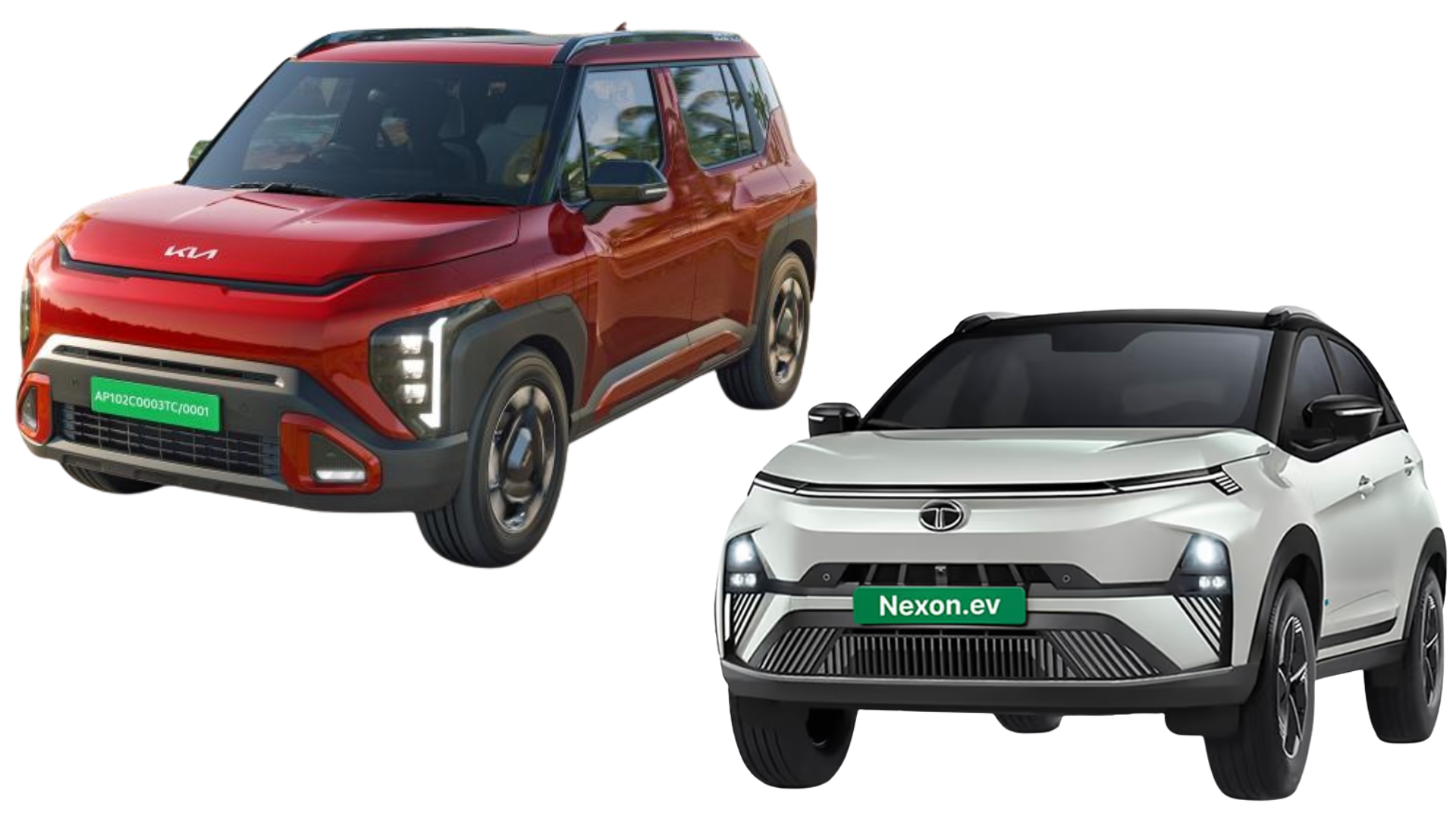
The Kia Syros EV has entered the compact electric SUV game with a rather strong specification sheet. The Tata Nexon EV, meanwhile, has been around long enough to know its way around this particular battlefield.
So, does Kia’s latest EV have enough ammunition to take on Tata’s established electric SUV?
On paper, it certainly does.
For this comparison, we’re looking at the top-spec Syros EV X-Line ER against the Tata Nexon EV Empowered+ A 45. The Syros EV is priced between Rs 13.49 lakh and Rs 19.99 lakh, while the Nexon EV’s 45 kWh top variant is priced at Rs 17.49 lakh, ex-showroom.
Interestingly, both SUVs measure almost exactly the same in length at around 4 metres. But that’s where the similarities largely end.
|
Kia Syros EV |
Tata Nexon EV |
|
|
Length |
3,995mm |
3,995mm |
|
Width |
1,805mm |
1,802mm |
|
Height |
1,670mm |
1,625mm |
|
Wheelbase |
2,550mm |
2,498mm |
|
Boot space |
390 litres |
350 litres |
|
Frunk |
16 litres |
11.6 litres |
|
Wheel size |
17-inch |
16-inch |
The Syros is 45mm taller and has a 52mm longer wheelbase, despite having the same overall length as the Nexon EV.
That extra wheelbase should be useful for rear-seat passengers, while the Syros also offers 40 litres more boot space. It even gets a slightly larger frunk. So, if you’re looking at these two purely from a packaging perspective, the Kia has the advantage.
The Battery and range battle
The top-spec Syros EV gets a 51.4 kWh battery, while the Nexon EV Empowered+ A 45 uses a 45 kWh battery.
The Kia’s electric motor also produces 171 hp and 255 Nm, compared with 144 hp and 215 Nm in the Nexon EV.
|
Kia Syros EV X-Line ER |
Tata Nexon EV Empowered+ A 45 |
|
|
Battery |
51.4 kWh |
45 kWh |
|
Motor |
Single motor |
Single motor |
|
Drive |
FWD |
FWD |
|
Power |
171 hp |
144 hp |
|
Torque |
255 Nm |
215 Nm |
|
0-100kph |
8.1 seconds |
8.9 seconds |
|
Claimed range |
526km |
489km |
The numbers tell a fairly straightforward story. The Syros has 27 hp and 40 Nm more, while its claimed range is 37 km higher.
It is also quicker to 100kph, although the difference isn’t exactly enough to turn this into a drag-race showdown at the next traffic signal.
Charging
The Syros EV supports up to 100kW DC fast charging, while the Nexon EV supports up to 60kW. Kia claims a 10-80 percent charge in around 39 minutes using a compatible 100 kW DC charger. The Nexon EV takes around 40 minutes for a 10-80 percent charge with its 60 kW DC setup.
So while charging times are surprisingly close, the Syros has the advantage when it comes to the maximum charging rate.
Both are loaded with features
The Syros EV and Nexon EV can both be equipped with features such as a panoramic sunroof, wireless Apple CarPlay and Android Auto, automatic climate control, wireless charging, ambient lighting, rear AC vents and OTA updates.
The Syros also gets some particularly interesting equipment, including its 30-inch Trinity display setup, Level 2 ADAS with 16 functions, V2L capability and an 8-speaker Harman Kardon audio system on the top X-Line ER.
The Nexon counters with features such as a 12.3-inch touchscreen, 10.25-inch digital instrument cluster, 9-speaker JBL audio system, ventilated front seats and a 360-degree camera.
So this isn’t a case of one SUV completely wiping the floor with the other. Both are properly loaded; they simply take slightly different approaches.
So, which one makes more sense?
If you look strictly at the specification sheet, the Syros EV comes out ahead. It has the larger battery, more powerful motor, higher claimed range, faster acceleration, longer wheelbase and bigger boot. It also brings some serious technology to the table.
The Nexon EV, however, has one major advantage that numbers can’t quite capture: it is the more established product. Tata has been selling the Nexon EV for years, and the model has built a strong presence in India’s electric-car market.
Also read: Nissan Tekton deliveries commenced, priced from Rs 10.49 lakh

