

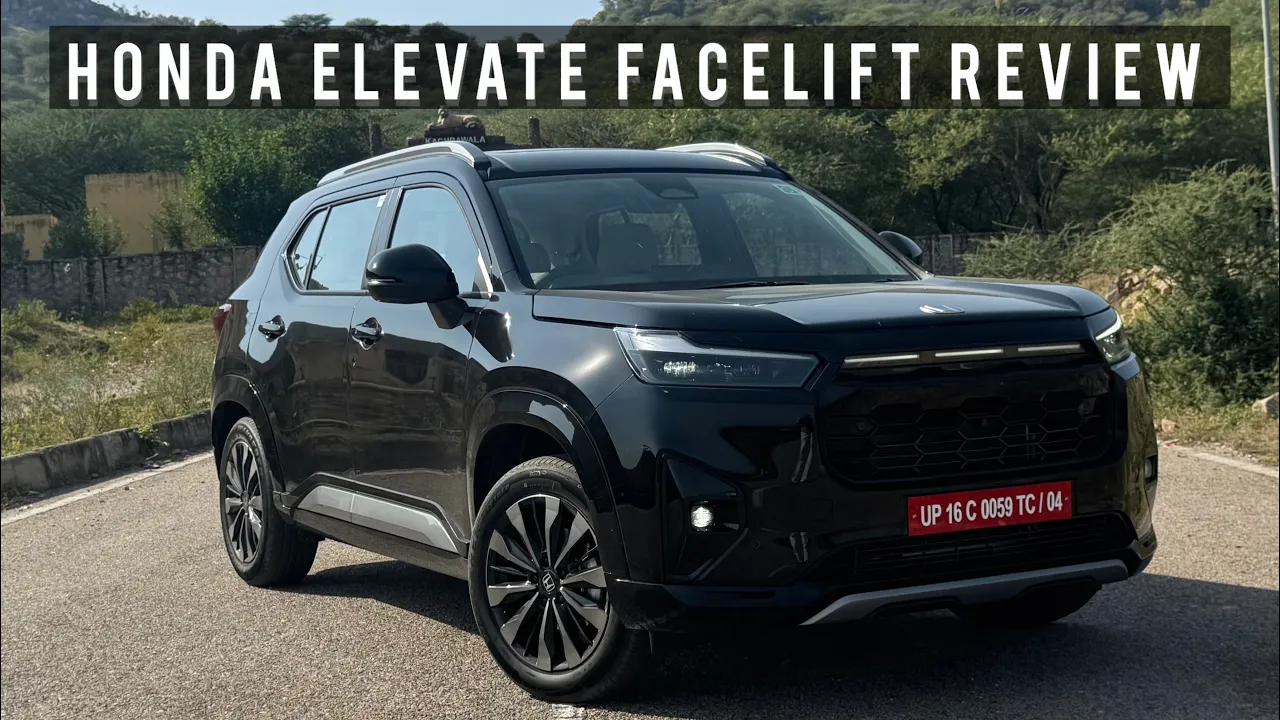
The Honda Elevate has always been a rather straightforward SUV. It doesn’t necessarily lead the segment in terms of outright performance, technology or an elaborate feature list, but it gets several fundamentals right. There is good cabin space, a comfortable ride, predictable handling and the kind of simple, no-nonsense engineering that Honda buyers have come to appreciate. With the 2026 facelift, Honda has attempted to address some of the areas where the Elevate was beginning to feel a little dated, without changing the mechanical package that made it a dependable family SUV.
Prices now start at Rs 11.80 lakh (ex-showroom), and the updates are fairly comprehensive when you look at the exterior, interior and equipment list. I drove the CVT version on the Delhi-Mumbai Expressway, after spending some time negotiating narrower city roads, and while the driving experience remains familiar, the improvements to refinement and comfort make this a more complete Elevate.
A sharper face and a more premium appearance
The most obvious changes are at the front, where the Elevate gets a redesigned gloss-black grille with a new three-part illuminated LED DRL arrangement. I particularly like the way Honda has executed this because it looks more like a series of individual marker lamps than one continuous LED strip. The Honda logo has also moved onto the bonnet, while the headlamps, LED fog lamps and conventional LED turn indicators complete the revised front-end treatment.
There is plenty of gloss-black cladding around the vehicle, including the lower sections of the bumpers and side profile, so buyers will have to be a little careful about scratches during ownership. The alloy wheels retain their familiar design but now get a machine-finished, dual-tone treatment. At the rear, the biggest change is the connected LED tail-lamp arrangement, with the illuminated section split around the centrally positioned Honda logo. It gives the vehicle a wider visual appearance without making the lighting look unnecessarily exaggerated.
A more welcoming cabin, with some big additions
The interior changes are arguably more significant than the exterior updates. Honda has introduced a lighter upholstery theme with contrasting darker sections, which makes the cabin feel brighter and more premium. There is additional soft-touch material on the dashboard and door trims, ambient lighting across all four doors, and a redesigned centre-console area with a wireless charging pad, USB Type-C ports and the familiar electronic parking brake.
The front seats are now power-adjustable, and both get three levels of ventilation. However, the most interesting addition is at the back, where the outer rear seats also get three-level ventilation. This is a particularly useful feature for Indian summers, especially when you regularly travel with family. The middle rear passenger misses out on seat ventilation, but you still get three adjustable headrests, rear AC vents, Type-C charging and a centre armrest with cupholders.
The single-pane sunroof continues, rather than being upgraded to a panoramic unit, while the front dashboard retains its floating touchscreen infotainment system and automatic climate-control panel. There is also an integrated air filter with PM2.5 air-quality information, while the digital-analogue instrument cluster remains easy to read even under strong sunlight. The 360-degree camera system is another useful addition, although the quality of the camera feed and touchscreen responsiveness are acceptable rather than particularly impressive. Apple CarPlay and Android Auto are available as well.
Honda has also updated its Level 2 Honda Sensing ADAS package, adding low-speed follow functionality, which should be particularly useful in bumper-to-bumper traffic. The facelift also gets a frameless electrochromic inside rear-view mirror. However, the boot remains unchanged in capacity, and the tailgate still needs to be opened and closed manually, without powered assistance.
The Familiar 1.5-litre petrol continues
Under the bonnet, there are no mechanical changes. The Elevate continues with Honda’s naturally aspirated 1.5-litre i-VTEC petrol engine with VTC, producing 121 PS at 6,600 rpm and 145 Nm at 4,300 rpm. You can choose between a six-speed manual and a seven-step CVT, with the latter offering a claimed fuel efficiency of 16.61 kmpl compared to 15.31 kmpl for the manual.
I was driving the CVT version, and the engine remains what it has always been: a fairly conventional naturally aspirated petrol motor that likes to rev. It doesn’t deliver an overwhelming surge of torque at low engine speeds, but there is enough performance for everyday city driving. Push harder and the engine is happy to climb towards its 6,500-rpm-plus operating range, giving you sufficient performance for highway overtakes as well.
In normal D mode, however, the CVT’s biggest advantage is its smoothness. Gear transitions are seamless, and there is very little head movement during acceleration. Even when you press the accelerator hard, the gearbox delivers the performance without making the occupants constantly move around in their seats. That makes it particularly convenient for everyday commuting.
Better refinement makes a difference
One of the key improvements Honda claims for the facelift is its NVH package, and there is a noticeable difference in the overall cabin experience. At around 100 km/h on the expressway, the engine remains reasonably subdued, and wind noise is also well controlled. It is only when you cross approximately 120 km/h that some wind noise starts creeping into the cabin, but that isn’t particularly concerning for normal driving conditions.
Under hard acceleration, the naturally aspirated engine does make its presence felt, especially when the CVT allows it to climb higher up the rev range. However, once you ease off the throttle, the cabin quickly becomes quieter. This improved insulation should make long-distance journeys less tiring, particularly for passengers who prefer a relaxed and quiet cabin.
Comfortable ride, predictable handling
The facelift retains the same chassis, suspension setup and wheel sizes, so the fundamental driving character hasn’t changed. Thankfully, the Elevate was already a comfortable SUV, and that continues to be one of its strongest attributes. The suspension deals with speed breakers and highway undulations in a mature fashion, allowing the vehicle to glide over imperfections without constantly disturbing the occupants.
The steering is also familiar, with a light operation that makes parking and city manoeuvres effortless. There is enough feel and feedback to give you confidence during faster lane changes, and the Elevate doesn’t exhibit excessive body roll when driven sensibly. It isn’t an SUV that you would want to attack corners like a hot hatch, but within its intended limits, the handling is predictable and reassuring.
Another important addition is disc brakes on all four wheels. The braking response is progressive rather than aggressively sharp, which should make it easier for someone upgrading to a larger or more premium vehicle to get accustomed to the stopping characteristics.
What about fuel efficiency?
During our drive of around 120 km, the Elevate returned approximately 13 kmpl, despite carrying three adults and luggage, spending some time idling and being driven at triple-digit highway speeds. With cruise control set between 80 and 100 km/h, I would expect the figure to improve towards the 15-16 kmpl mark, which would bring it closer to Honda’s claimed CVT efficiency.
Of course, spending most of your time in bumper-to-bumper city traffic, particularly with E20 petrol, could bring the efficiency down further. The Elevate isn’t particularly demanding when it comes to driving technique, though, and its conventional petrol powertrain should appeal to buyers who prefer a familiar ownership experience without having to think about charging or hybrid systems.
Verdict
The 2026 Honda Elevate facelift is not an entirely new SUV, nor does it attempt to reinvent its driving experience. Instead, Honda has concentrated on areas that needed attention, adding a more attractive exterior treatment, a significantly improved cabin ambience, ventilated rear seats, powered front seats, a 360-degree camera and updated ADAS functionality. The improvements to NVH are particularly welcome because they make an already comfortable SUV more relaxing on longer journeys.
There are still shortcomings. The infotainment system could be more responsive, the camera quality isn’t particularly impressive, and a powered tailgate would have been a useful addition. The naturally aspirated petrol engine also doesn’t offer the kind of outright performance that some turbocharged rivals deliver. But the Elevate continues to get the fundamentals right, and that is precisely why it remains an appealing proposition.
Also read: 2026 BMW X3 xDrive 30 M Sport Pro Review

