

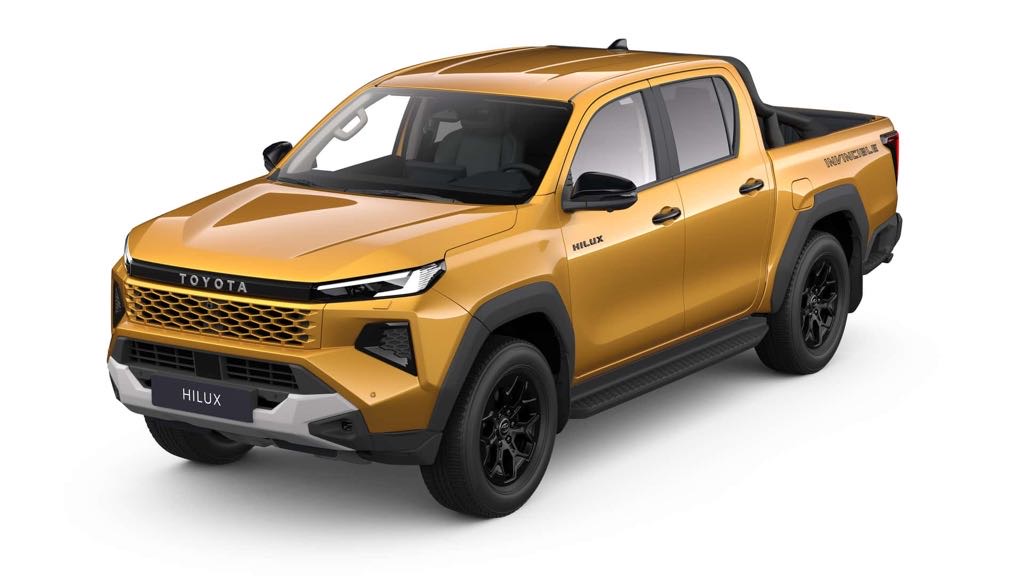
Key highlights
- Toyota Hilux will not get a PHEV
- Toyota says that the PHEV drivetrain will reduce the payload capacity
- A hydrogen fuel-cell (FCEV) Hilux could be launched
In a recent media conversation with CarExpert Australia, Toyota Australia’s Vice President of Sales and Marketing and Franchise Operations, John Pappas, revealed that Toyota has no plans to introduce a plug-in hybrid or any hybrid Hilux iteration. The reason behind this decision is simple – Hilux customers have “other” expectations than the rival brand customers.
No PHEV Hilux
Let us explain what it means. The Hilux pickup truck is famous worldwide for its extremely rugged nature and payload capacity. Toyota says that its customers have higher expectations with Hilux than they would have for rivals like the Ford Ranger, etc. Introducing a PHEV drivetrain is not a big deal, but it will eventually cut off the core strength of the Hilux, which is its payload capacity, towing capacity, and rugged framework.
While Toyota is known for developing new PHEVs like the Prius, Camry Hybrid, etc, the brand says that it will not only have to rework the ladder-frame IMV platform, but it will also have to cut down the flat bed length and rear seat space to accommodate the big batteries and 4WD configuration if it were to make a plug-in hybrid Hilux. Therefore, it is far more suitable not to make one and continue selling it with the proven and powerful current engine options.
Hydrogen Fuel Cell Toyota Hilux could become a reality
Meanwhile, John Pappas also revealed that making a Hydrogen Fuel Cell (FCEV) Hilux would be far more suitable. The FCEV drivetrain not only uses smaller fuel tanks, but the hydrogen fuel has 150 times more energy density than the PHEV. Cutting it short, an FCEV will be lighter, it will offer at least 600 km range, and it could be refuelled in 3 to 5 minutes.
With that said, Toyota did not reveal whether the current-gen Hilux will get an FCEV update in the future or not. However, the brand is all set to launch the new-generation Hilux in India on July 28. It is expected to hit the road by the end of this year, and it will most likely be offered with the 2.8-litre turbo diesel engine paired with a 48V mild-hybrid drivetrain.
Also read: Volkswagen Tayron Life variant launched with 5-seater configuration

