

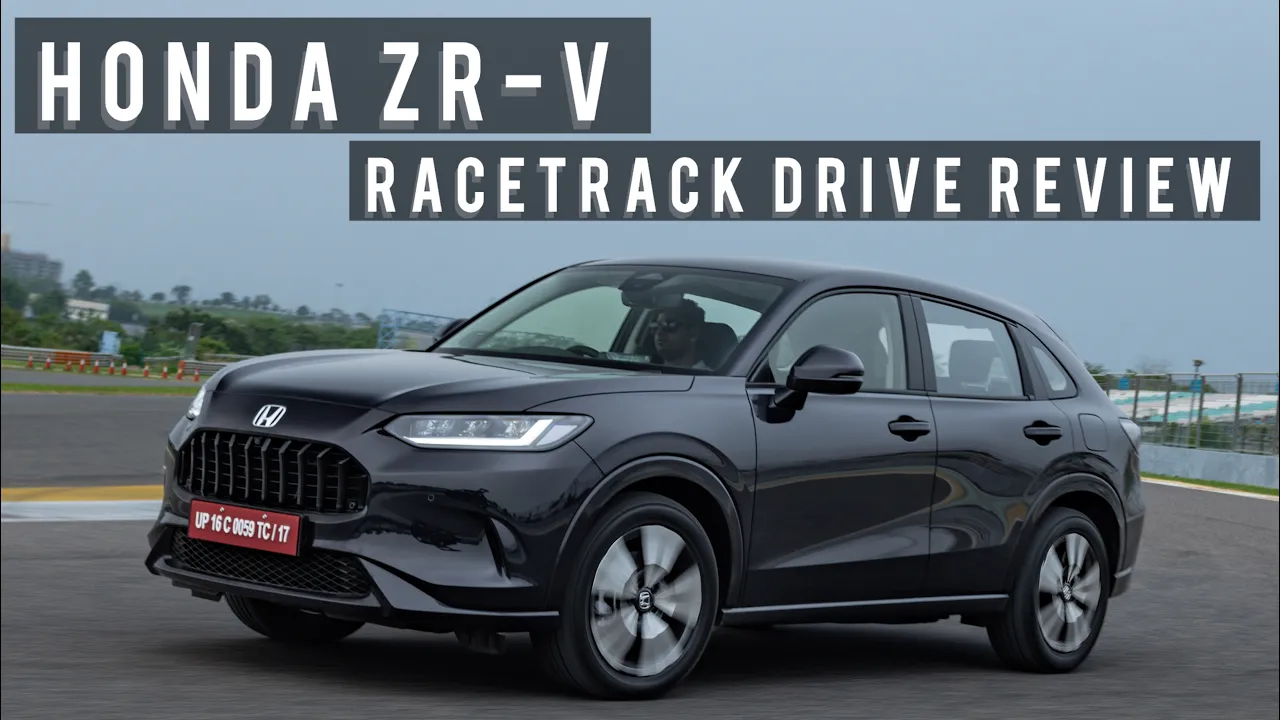
There are some cars that make a strong first impression even before you start driving them. The Honda ZR-V isn’t necessarily one of them. It looks fairly understated. The cabin doesn’t scream luxury. The feature list isn’t particularly extravagant for something positioned at a premium price point. And then there is the fact that this is a strong-hybrid SUV, which immediately makes you think efficiency rather than driving pleasure.
I recently drove the Honda ZR-V at the Buddh International Circuit, and that experience changed the way I looked at this SUV. The ZR-V may have been engineered primarily as an efficient, comfortable urban SUV, but there is considerably more depth to its driving experience than the brochure might suggest.
This is a car that can quietly cruise around town in EV mode, deliver impressive fuel efficiency and then surprise you with how confidently it handles when the road gets interesting.
Performance
The Honda ZR-V gets a 2.0-litre strong-hybrid powertrain that produces 184 PS and a cumulative 315 Nm of torque. Honda claims a 0-100 kmph time of 7.9 seconds, which is more than respectable for an SUV designed primarily around efficiency.
The ZR-V doesn’t feel like a sluggish hybrid that has sacrificed performance entirely in the pursuit of mileage. Put your foot down and there is enough electric shove to build speed rapidly. On the track, it was capable of crossing 100 kmph without much fuss and continued past 150 kmph with relative ease. There is, of course, some engine noise when you ask for maximum performance. But it isn’t particularly coarse or unpleasant. The transition between electric propulsion and the engine coming to life is also fairly seamless during normal driving.
The hybrid system is particularly interesting at lower speeds. The ZR-V can operate in pure EV mode, while the petrol engine can also function as a generator to charge the battery. As a result, even when the EV mode indicator disappears, the engine isn’t necessarily driving the wheels directly all the time.
For someone spending most of their time in city traffic, this should translate into a relaxed and efficient driving experience. Honda claims 22.8 kmpl, and while our track driving obviously isn’t representative of real-world urban usage, the car was still displaying 13.6 kmpl despite being driven hard around the circuit. That is encouraging for a hybrid SUV.
Surprisingly good to drive
This is where the Honda ZR-V genuinely caught me off guard. The ZR-V isn’t a sports SUV. It isn’t pretending to be one either. But its steering, chassis and suspension work together remarkably well. The steering doesn’t feel excessively light or vague. There is no significant dead zone around the centre, and even small steering inputs result in an immediate response from the car. More importantly, the steering gives you a fairly good idea of where the front wheels are pointing.
On the slalom section of the circuit, the SUV remained composed even when subjected to quick steering inputs. The body does move, as you would expect from an SUV, but the movements are controlled and predictable.
The proportions of the ZR-V certainly help. Unlike a tall, boxy SUV, it has a relatively lower-slung stance. That helps keep the centre of gravity lower and contributes to the sense of stability you experience behind the wheel. Attack a corner and the ZR-V doesn’t suddenly feel nervous or out of its depth. Instead, it follows the line you have chosen with confidence.
Even during high-speed lane-change manoeuvres at around 100 kmph, the body remained well controlled and the steering responded quickly enough to bring the vehicle back onto the intended line without requiring excessive correction.
Suspension and brakes
The Buddh International Circuit is obviously not the ideal place to judge ride quality. The track surface is considerably better than the roads most Indian SUVs will encounter every day. So I wouldn’t use this drive to make any definitive claims about how the ZR-V will deal with potholes, broken tarmac or sharp-edged speed breakers.
What the track does reveal, however, is how well the suspension controls the body when the vehicle is pushed hard. The ZR-V remains composed through fast switchbacks and direction changes. There is some pitch and roll, but it never feels excessive for an SUV of this type.
The brakes are equally easy to understand. There is a reassuring amount of pedal feel right from the initial input, rather than a long, vague first phase followed by sudden braking force. That predictability becomes particularly useful when you’re driving quickly and need to modulate the brakes precisely.
The hybrid system also allows you to adjust the level of regenerative braking using the paddle shifters. At maximum regeneration, the car slows down noticeably when you lift off, although it doesn’t behave like an EV with a true one-pedal driving system.
A quiet and relaxed cabin
The ZR-V also makes a good case for itself as a daily driver. At low speeds, especially when the car is operating in EV mode, the cabin is pleasantly quiet. Honda says it has worked on areas such as the floor, wheel arches, internal linings and acoustic glass to improve NVH levels.
The result is a cabin that feels appropriately refined. You can hear the engine when it fires up, but the transition isn’t harsh. Even under hard acceleration, the noise doesn’t become particularly intrusive.
The power-flow display is also useful. It shows whether the battery is powering the vehicle, whether the engine is driving the wheels and when energy is being sent back into the battery. The information is presented clearly enough to understand what the hybrid system is doing without requiring you to be an engineer.
The instrument cluster itself is one of the better parts of the interface. It is nicely recessed, has good contrast and remains easy to read even under bright sunlight. The infotainment screen, however, isn’t quite as impressive. There is some noticeable lag, and for a vehicle in this price category, the touchscreen experience could certainly be better.
Where the ZR-V falls short
It doesn’t necessarily feel as expensive as its price tag might suggest. Being a fully imported CBU, the ZR-V is expected to command a significant premium. Yet visually, it is fairly restrained. The interior doesn’t overwhelm you with expensive-looking details either.
The feature list also doesn’t have the sort of headline-grabbing equipment you might expect at this price. There isn’t even a single-pane sunroof, let alone a panoramic unit. For buyers who judge a car primarily by its features, cabin presentation and perceived luxury, the ZR-V could therefore be a difficult proposition.
The seats are another small consideration. They held me securely during hard cornering, and the bolstering worked well for my body type. However, larger occupants may find them slightly restrictive.
Verdict
The Honda ZR-V is an interesting SUV because its biggest strength isn’t necessarily something you can appreciate while browsing the specification sheet. It is the way it drives.
Yes, it is a hybrid. Yes, efficiency is an important part of its appeal. Yes, it is designed primarily as an urban SUV. But Honda hasn’t forgotten that driving a car should also be enjoyable. At the same time, it can quietly cruise around town in EV mode and promises the kind of fuel efficiency that makes sense for daily use.
The bigger question is whether that driving experience justifies the premium you will pay for a fully imported SUV that doesn’t necessarily feel particularly extravagant.
Also read: 2026 Renault Duster Review

