

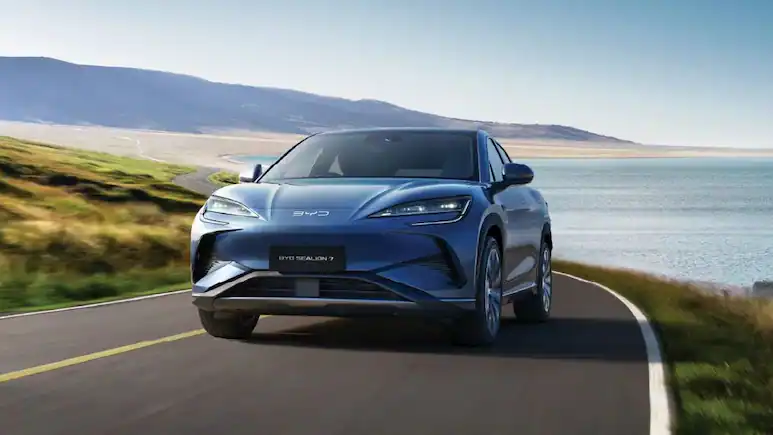
Key Highlights
- BYD Chairman Wang Chuanfu declared at the company’s annual shareholder meeting that BYD will become the world’s largest automaker by scale within five years.
- BYD sold 4.8 million vehicles in 2025 against Toyota’s 11.3 million.
- It recently overtook Ford in global sales for the first time. BYD is targeting 1.5 million overseas deliveries in 2026.
BYD Chairman Wang Chuanfu does not do understatement. At the company’s annual shareholder meeting in Shenzhen, he told investors exactly what he is aiming for.
“BYD will truly become the number one automaker globally in terms of scale in five years,” Wang said.
That means by 2031. That means overtaking Toyota. And that means more than doubling BYD’s current annual sales.
The gap is still enormous
Let us be clear about the numbers. Toyota sold 11.3 million vehicles globally in 2025. BYD sold 4.8 million. That is a gap of 6.5 million units. Even with BYD’s extraordinary growth trajectory, closing that distance in five years is an exceptional ask.
But dismissing it entirely would be a mistake. Three years ago, BYD was a relatively unknown brand outside China. Today it has overtaken Ford in global sales and is the world’s largest EV maker. Its overseas sales grew 80 percent in May 2026 alone, reaching 160,000 units in a single month for the first time.
BYD is targeting 1.5 million overseas deliveries in 2026 and is building deep localisation in key markets across Europe, Southeast Asia, Australia, Brazil, Mexico, and the UK. In Australia and Brazil, it is already the best-selling EV brand, ahead of Tesla.
What BYD has going for It
Two things matter most here. Technology and pricing. BYD’s next-generation Blade Battery 2.0 and its Flash Charging platform support charging speeds of up to 1,500 kW on compatible vehicles. A charge from 10 to 80 percent in five minutes is where this technology is heading. No other mainstream manufacturer is close to that.
On pricing, BYD’s ability to manufacture vehicles at a cost that European and Japanese brands struggle to match gives it a structural advantage in emerging and price-sensitive markets.
Wang also announced a GBP 1.8 billion investment to build 5-minute fast-charging infrastructure across Europe. That is not marketing. That is commitment.
Can it actually happen?
BYD’s home market growth is beginning to moderate, which makes overseas expansion critical. Toyota is not standing still either. The Japanese giant is investing heavily in electrification and has a manufacturing and dealer network that took decades to build.
Five years is a short time in the automotive world. But then again, nobody expected BYD to overtake Ford either.
Also read: Tesla Model Y L deliveries begin in India, prices start at Rs 61.99 lakh

