

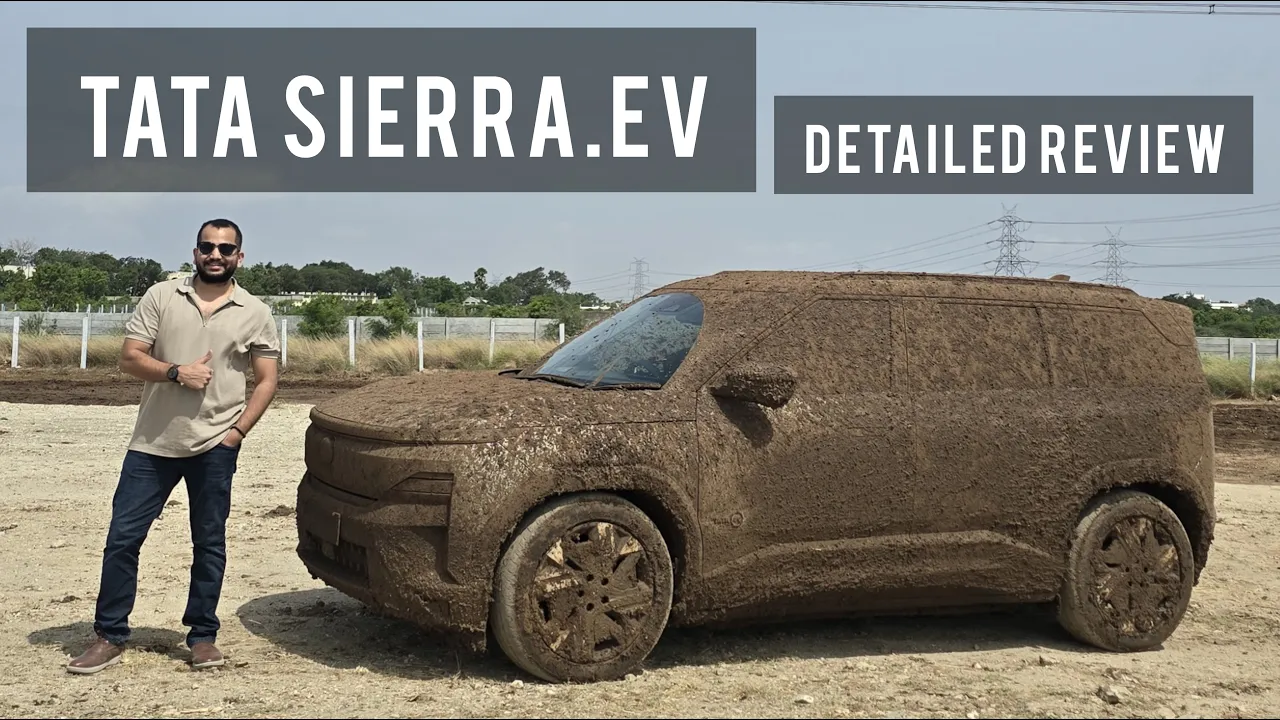
The Tata Sierra name has made a comeback, and this time it has an electric motor powering it into the future. The 2026 Tata Sierra.ev is not merely an electric version of the new Sierra. With a dual-motor, all-wheel-drive setup, a large 75 kWh battery and an additional Boost mode, it also promises performance and off-road capability that you wouldn’t normally associate with a family-oriented electric SUV.
Prices for the Sierra.ev start at Rs 18.79 lakh, while the 75 kWh dual-motor version sits at the top of the range.
I spent time driving the Sierra.ev through city roads, highways, winding sections, an off-road obstacle course, sandy trails and even a slush pit. Here’s what it is really like from behind the wheel.
A Familiar Sierra
The Sierra.ev retains the same basic design language as the new-generation ICE Sierra, which is a good thing because this is one of those designs that doesn’t need to scream for attention. The biggest visual difference is at the front. Since there is no conventional engine, the traditional grille has been replaced by a largely blanked-out gloss-black section. The EV-specific Tata logo gets white accents, while the connected LED DRLs, sequential turn indicators, LED headlamps and fog lamps remain similar to the ICE version.
Move to the side and the 19-inch aerodynamic alloy wheels immediately stand out. They are wrapped in low-rolling-resistance MRF tyres and also get TPMS. The lower body cladding has been revised to accommodate and protect the battery pack mounted underneath the floor. Interestingly, ground clearance is slightly better than the ICE Sierra.
There is also an EV-specific charging port, illuminated to indicate the battery’s charging status. The rest of the design remains largely unchanged, including the flush-fitting door handles, roof rails and, most importantly, the large glasshouse inspired by the original Sierra.
A proper family SUV inside
The Sierra.ev is spacious, and that’s one of its biggest strengths. At 5’8″, I had no trouble getting comfortable in the driver’s seat. The driver gets a powered seat with memory and ventilation, while the steering column gets tilt and telescopic adjustment. The front passenger also gets a powered, ventilated seat, although height adjustment isn’t available there.
The rear seat is where the Sierra.ev really impresses. There’s plenty of knee room, good thigh support and generous headroom. The rear bench gets adjustable backrest angles, three headrests and a centre armrest with cupholders. But the biggest party trick is the flat floor. Because this is a pure EV architecture, the centre passenger doesn’t have to deal with a large transmission tunnel. My feet could sit completely flat on the floor, making the middle seat genuinely usable.
The boot space remains identical to the ICE Sierra because the battery is positioned underneath the floor. There’s also a 17 kg-capacity frunk, which adds another layer of practicality. One small warning: the powered tailgate doesn’t open particularly high, so taller users need to be careful. I learnt that the hard way.
A feature-packed cabin
The top-spec Sierra.ev gets a triple-screen dashboard comprising a digital instrument cluster, central infotainment display and a dedicated passenger screen. The instrument cluster gets multiple layouts and can display navigation information. The passenger screen can also be used for entertainment and gaming, with a smartphone capable of acting as a controller.
You also get Dolby Atmos, Apple CarPlay, Android Auto, a head-up display, wireless charging, dual-zone climate control, an electrochromic rear-view mirror and ambient lighting. The panoramic dual-pane sunroof makes the cabin feel even more spacious. Tata says it is the largest dual-pane sunroof in its segment.
There are plenty of physical controls too, which is something I appreciate. The gear selector is compact and frees up space on the centre console for storage and cupholders. The only real ergonomic complaint I had was with the climate-control panel. The touch-sensitive buttons are packed quite closely together, making accidental inputs possible.
Battery and powertrain performance
The Sierra.ev is offered with 63 kWh and 75 kWh battery options. The larger battery can be paired with the dual-motor AWD setup. The front motor produces 140 PS, while the rear motor produces 209 PS. The combined output is rated at 306 PS and 504 Nm. Tata claims a 0-100 km/h time of 5.8 seconds.
The 75 kWh rear-wheel-drive version gets a claimed range of up to 665 km, while the dual-motor AWD version gets up to 624 km. The 63 kWh version is claimed to deliver up to 535 km. The Sierra.ev also gets four driving modes; Eco, City, Sport and Boost. Boost is exclusive to the dual-motor version. There are four levels of regenerative braking, controlled using paddles behind the steering wheel. However, there is no true one-pedal or i-Pedal mode, so even at the highest regeneration setting, the vehicle continues to crawl rather than coming to a complete stop.
Select Boost, put your foot down and the Sierra.ev simply takes off. The acceleration is rapid enough to make you question whether you’re actually driving a family SUV. The claimed 5.8-second 0-100 km/h time feels believable. But what’s more interesting is that the performance isn’t restricted to Boost mode. Even in Eco, a full-throttle input produces surprisingly strong acceleration. That makes the Sierra.ev one of those cars where you don’t need to select a special mode every time you want to overtake. There’s always plenty of performance available.
Comfort
Tata has got the suspension tune right. The Sierra.ev uses frequency-selective dampers, and they do a very good job of keeping the SUV composed over broken surfaces. Speed breakers are handled maturely, the car doesn’t feel excessively floaty at highway speeds and the suspension absorbs smaller undulations without disturbing the cabin. The seats are also wide and supportive, with ventilation adding to long-distance comfort.
The 19-inch wheels do mean that sharp potholes can sometimes send a more pronounced thud into the cabin, but overall, the ride quality is excellent. During the off-road course, the suspension absorbed logs, rocks, articulation sections and even the impact of the seesaw obstacle without transmitting excessive shock into the cabin.
Capable off-roader
The AWD version gets six terrain modes: Normal, Snow & Grass, Mud & Ruts, Sand, Rock Crawl and Custom. The dual-motor system constantly manages torque between the four wheels. When one wheel loses traction, power is redirected to the wheels with better grip.
On gravel, logs, articulation sections, steep inclines, side slopes and rock beds, the Sierra.ev simply crawled through. The low centre of gravity, courtesy of the battery mounted beneath the floor, also helps when tackling steep side slopes.
The camera system is particularly useful here. A view of what’s underneath the vehicle helps you understand wheel placement when the bonnet is pointing skywards or you’re approaching a tricky obstacle.
The Sierra.ev also handled sandy trails impressively. Even after deliberately stopping in loose sand and allowing the wheels to dig in, a measured throttle input was enough to get the vehicle moving again.
That said, the fact that it is an electric AWD SUV shouldn’t encourage reckless off-roading. The instant torque means you need to be smooth with the throttle, and EV owners venturing away from civilisation need to keep a close eye on battery charge.
Handling
The Sierra.ev isn’t a sports SUV, and it doesn’t pretend to be one. The steering is light at low speeds, making parking and tight manoeuvres effortless. At higher speeds, it provides reasonable feedback and enough confidence to place the vehicle accurately.
There is some vagueness around the centre, particularly with ADAS active, as the system constantly makes small corrections to keep the vehicle within its lane. Push harder into a corner and you will feel some body movement. That’s simply physics. This is still a large, tall SUV. The low centre of gravity helps, but it doesn’t magically turn the Sierra into a sports car.
Braking And Regeneration
Regeneration at Level 3 is strong enough to significantly slow the vehicle as soon as you lift off the accelerator. In everyday driving, this means you won’t need to touch the brake pedal very often. It should also help reduce brake-pad wear over time.
The conventional brakes offer good bite when you actually need them, and during hard braking, the Sierra.ev remained stable despite some expected nose dive. The emergency braking test also showed good composure, with the hazard lights activating under heavy braking to warn other road users.
Final Thoughts
The Tata Sierra.ev is one of those cars that is difficult to fault after a full day behind the wheel. It is spacious, comfortable, feature-loaded and extremely quick. More importantly, it doesn’t feel like Tata simply took the Sierra, replaced the engine with batteries and called it an EV.
The Sierra.ev manages to be a comfortable urban family car on Monday, a rapid highway cruiser on Friday and a surprisingly capable off-roader on Sunday.
Also read: 2026 Tata Punch facelift review

