

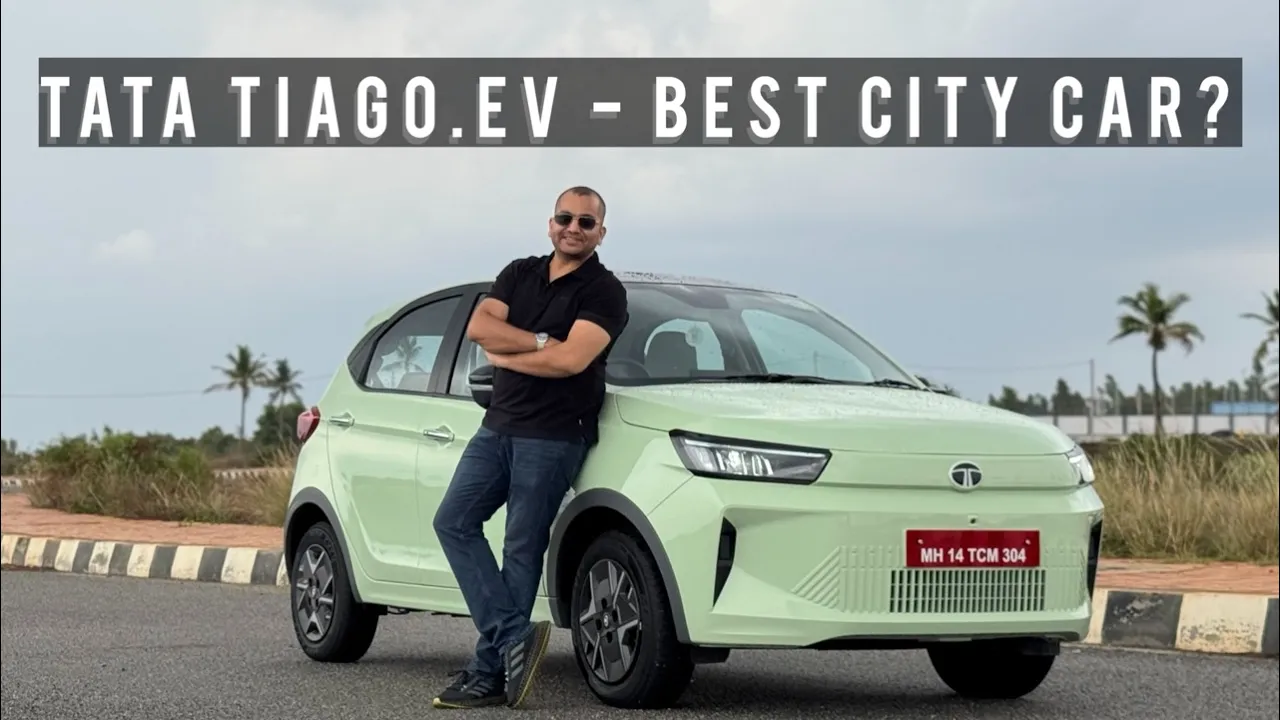
The 2026 Tata Tiago EV facelift may not be an all-new electric car, but it has received enough updates to make it feel considerably fresher from behind the wheel. The battery and motor hardware remain broadly similar to the pre-facelift model, but Tata Motors has made changes to the calibration, suspension tuning, safety package and overall cabin experience.
After spending time driving it in the real world, the Tiago EV makes a strong case for itself as a practical city car.
Smooth, quiet and easy to drive
The biggest strength of the Tiago EV remains how easy it is to drive. The power delivery is progressive in City mode, making it particularly well suited to urban traffic. Even when you push the accelerator for an overtake, the momentum builds smoothly rather than delivering a sudden shove that could unsettle passengers.
Sport mode, naturally, makes things considerably livelier. But for everyday commuting, City mode makes more sense. It keeps the acceleration predictable and relaxed, while still offering enough performance to deal with traffic and quick overtakes.
The Tiago EV is also impressively quiet. The inherent refinement of an electric powertrain, combined with the car’s overall NVH performance, makes it a particularly pleasant proposition for daily office commutes. The review experience found very little to complain about in terms of the car’s basic drivability.
Ride and handling have been tweaked
The suspension has been retuned for the facelift, and the changes are noticeable. Tata hasn’t attempted to turn the Tiago EV into something sporty. Instead, the focus is clearly on making it comfortable and predictable.
The result is an EV that feels composed during everyday driving while retaining the easy-going character expected from a small city car.
The steering is also straightforward and easy to understand. That makes the Tiago EV approachable even for someone buying an EV for the first time.
Range
The smaller battery pack has a claimed range of 226 km, but the real-world expectation from the drive experience is closer to 160-170 km. That is a significant difference from the claimed figure, but it is still sufficient for most urban use cases.
In fact, the review suggests that a high-usage owner could potentially need to charge the car every three to four days, while someone using it as a second car may only need to plug it in about once a week.
Tata also claims that 18 minutes of fast charging can add roughly 100km of driving range, which could be particularly useful for owners who rely heavily on their cars during the week. A 3.3kW AC wallbox charger is included with the vehicle.
The car gets four levels of regenerative braking, from zero to maximum. There is, however, no single-pedal driving mode. Even at the highest regeneration setting, lifting off the accelerator slows the car down only to a crawl rather than bringing it to a complete stop.
The biggest caveat
One feature that could have made the Tiago EV even better in everyday traffic is auto hold. The car uses a manual handbrake instead of an electronic parking brake, which means there is no auto-hold function either. Lift off the brake pedal in traffic and the car simply begins to crawl forward.
It isn’t a deal-breaker, but considering how naturally suited an EV is to stop-go city driving, an auto-hold function would have made the Tiago EV considerably more convenient.
A compelling city EV
The 2026 Tata Tiago EV facelift starts at Rs 6.99 lakh, while buyers can also opt for Tata’s Battery-as-a-Service arrangement, which lowers the initial acquisition cost. More importantly, Tata is offering a lifetime, unlimited-kilometre battery warranty for the first owner, while the second owner gets an eight-year/1.6-lakh-kilometre warranty.
That makes the Tiago EV particularly interesting for buyers who are still worried about long-term battery ownership.
After the drive, the verdict is fairly straightforward, the 2026 Tata Tiago EV is easy to drive, quiet, comfortable and sufficiently practical for everyday urban use. It isn’t a revolutionary new EV, but it doesn’t need to be.
Just keep your expectations realistic about the real-world range, and remember that the lack of auto hold and single-pedal driving could matter to some buyers.
For someone looking for a relatively affordable, efficient and fuss-free city EV, however, the Tiago EV facelift deserves to be on the shortlist.
Also read: 2026 Tata Punch facelift review

