

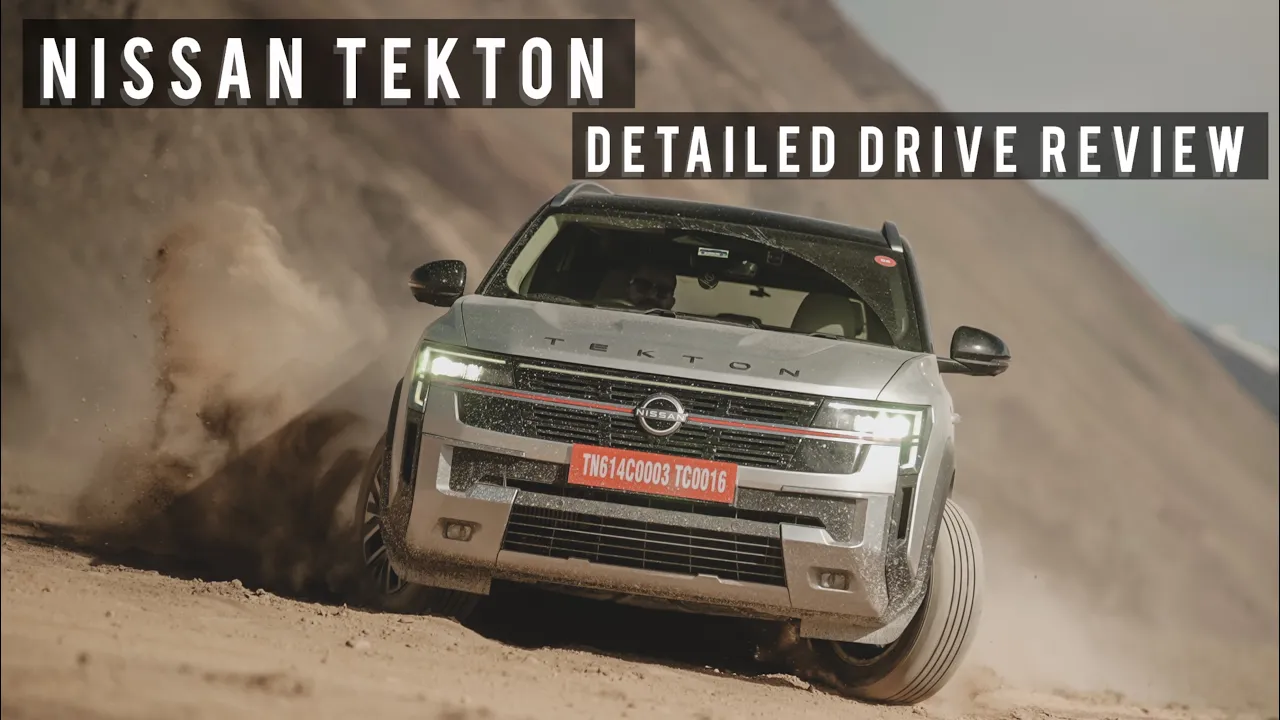
The Nissan Tekton enters one of India’s most fiercely contested automotive segments the mid-size SUV space. It goes up against established names such as the Hyundai Creta, Kia Seltos, Maruti Suzuki Victoris and Grand Vitara, Toyota Urban Cruiser Hyryder, Volkswagen Taigun and Skoda Kushaq. That is a tough crowd to compete with, especially for Nissan, a brand that has been relatively quiet in the Indian market.
The Tekton shares its core engineering with the new Renault Duster. The engine, gearbox, chassis and suspension hardware are essentially shared, although Nissan has given the Tekton its own exterior design, interior treatment and calibration. After spending considerable time behind the wheel, including on winding Himalayan roads and at high altitude, it is clear that Nissan has not simply rebadged the Duster and called it a day.
A proper SUV design
The Tekton immediately makes a strong impression on the road. Its design is noticeably different from the Duster, with prominent bonnet power bulges, a wide front-end treatment and Nissan’s signature C-shaped lighting elements. The connected LED DRLs give the front a modern appearance, while LED headlamps and fog lamps complete the lighting package. The fog lamps, however, sit rather low, so owners driving regularly over rough terrain will need to be careful.
There is plenty of black cladding around the wheel arches and lower body, giving the Tekton a rugged, rough-road-friendly appearance. The 18-inch diamond-cut alloy wheels fill the wheel arches nicely without making the SUV look unnecessarily flashy. The dual-tone treatment works particularly well on lighter colours. The blacked-out A, B, C pillars, combined with the black roof and panoramic sunroof, give the Tekton a floating-roof effect.
At the rear, connected LED tail lamps and the smoked lighting treatment give it a wide stance. The prominent wheel arches and squatting posture also help it look substantially larger than some of its European rivals. The overall design is one of the Tekton’s strengths. It looks premium without being overstyled and rugged without trying too hard to look like an off-roader.
A premium cabin
Step inside and the Tekton makes another strong case for itself. The biggest difference compared with the Duster is the interior treatment. Nissan has opted for a much lighter and more interesting colour combination, with beige, purple, black and gold accents. It gives the cabin a brighter and more premium appearance.
The dashboard design is modern without being unnecessarily complicated. There is a digital instrument cluster alongside a touchscreen infotainment system, and Nissan has added its own software skins and interfaces to differentiate the experience. The digital cluster gets multiple layouts, including a conventional circular display, navigation and information-focused screens. It is easy to operate and remains legible even under bright sunlight.
The touchscreen gets built-in Google Maps, smartphone connectivity and a 360-degree camera. The camera feed could be sharper, but it remains useful for manoeuvring a vehicle of this size. There is also a dynamic chassis display showing information such as pitch and roll, while hill-descent control and driver-assistance settings are easily accessible.
The physical climate-control controls are another highlight. Unlike many modern SUVs that bury everything inside a touchscreen, the Tekton retains tactile controls that are easy to operate while driving. There are, however, a few ergonomic misses. The engine start/stop button is somewhat awkwardly positioned, while the dead pedal is too narrow and tilted at an odd angle. The wireless charging pad is large enough for modern smartphones but isn’t particularly easy to access.
The cabin itself feels well finished. Soft-touch materials, contrasting accents, illuminated storage areas and a frameless electrochromic mirror add to the premium ambience.
Plenty of space
The Tekton is a genuine five-seater and does a good job of utilising its footprint. The front seats are electrically adjustable, with height adjustment for both driver and passenger. The driver also gets lumbar adjustment, while the seats have good bolstering and ventilation.
Move to the second row and there is enough legroom for taller passengers. The front seats can be pushed forward significantly, making the Tekton suitable even for chauffeur-driven usage. The rear bench gets three adjustable headrests, three-point seat belts, AC vents, Type-C charging ports and an armrest with cupholders. The transmission tunnel isn’t particularly intrusive, although a fifth passenger will still be more comfortable with shorter journeys.
The panoramic sunroof makes the cabin feel even more spacious. A missing rear sunshade, however, is a surprising omission in a vehicle positioned as a premium mid-size SUV. Boot space is generous enough for a family road trip, with room for several cabin-sized suitcases. The 60:40 split rear seats add further flexibility.
Powertrain
Under the bonnet sits Nissan’s 1.3-litre four-cylinder turbo-petrol engine producing 163 PS and 280 Nm. Buyers can choose between a six-speed manual and a six-speed wet dual-clutch automatic. It DCT is quick without being jerky, and gearshifts are smooth enough that passengers aren’t constantly aware of what the transmission is doing. The paddle shifters also allow greater control when attacking winding roads.
In Eco mode, the Tekton isn’t frustratingly slow. The engine will happily stay in a higher gear and build speed progressively rather than constantly downshifting. But press the accelerator harder and the turbo comes alive, giving the SUV a noticeable surge of acceleration. There is also an addictive little turbocharger blow-off sound when you lift off the accelerator. It isn’t loud enough to be intrusive, but enthusiasts will enjoy hearing it.
Nissan claims 17.8 kmpl for the manual and 18.5 kmpl for the DCT. During a roughly 240-km drive through Chandigarh and the Himalayan region, the test car returned around 14 kmpl, which is encouraging considering the terrain and driving conditions. City mileage will naturally be lower, particularly in heavy traffic, but the engine appears reasonably efficient for its performance.
Brilliant on winding roads
This is where the Tekton really separates itself from much of the segment. The steering is exceptionally well balanced. It is light enough at parking speeds but gains weight as speeds rise. More importantly, it tells you what the front wheels are doing. Through continuous mountain switchbacks, the Tekton feels composed and predictable. There is very little need to fight the car or constantly correct its trajectory.
The chassis deserves similar praise. Despite being a tall SUV, the Tekton doesn’t feel excessively wallowy or nervous when pushed through corners. There is some body movement if you enter a corner aggressively, as physics demands, but it never feels alarming. The combination of steering, chassis, tyres and suspension gives the driver plenty of confidence.
The suspension is arguably the Tekton’s biggest strength. Nissan and Renault reportedly went through more than 80 iterations before settling on the final suspension tune. Whatever the exact number, the end result works. Speed breakers, broken surfaces, potholes, gravel and rough patches are handled with remarkable maturity. The suspension is comfortable without becoming excessively soft or floaty. This is the kind of SUV that feels equally at home on a highway, in the city or on a badly broken mountain road.
The 18-inch wheels do mean that particularly sharp potholes can be felt inside the cabin, but overall ride quality is excellent.
What happens at high altitude?
The real test came much higher up in the Himalayas. The Tekton was driven from Chandigarh towards Manali and further into the mountains, eventually reaching elevations of around 4,500–4,700 metres while climbing towards Shinkula Pass. This matters because turbo-petrol engines still have to deal with thinner air at altitude. The Tekton coped remarkably well.
There was some additional effort required when pulling away from a standstill, but once the car was moving, the engine continued to deliver strong and consistent performance. The gearbox also did a good job of selecting the appropriate gear without constantly hunting between ratios. Even in Eco mode, the Tekton was capable of maintaining momentum and overtaking slower traffic on mountain roads.
More impressive was the chassis. The steering remained confidence-inspiring through tight corners, while the suspension continued to absorb broken surfaces without unsettling the vehicle. The seats also provide enough bolstering to keep the driver properly planted during enthusiastic driving.
Even at high altitude, a full-throttle run managed to take the Tekton to 100 kmph without feeling completely out of breath.
Brakes, NVH and everyday usability
Braking performance is predictable, with decent pedal feel and progressive stopping power. The ABS did not feel unnecessarily intrusive during the testing.
Noise insulation is also good. At normal highway speeds, tyre and wind noise remain well controlled. The engine becomes more audible when you deliberately hold lower gears and push hard, but it isn’t coarse or unpleasant.
The air-conditioning is effective, although the blower becomes quite loud at its higher settings. Nissan has also equipped the Tekton with Level 2 ADAS, and the system feels relatively unobtrusive. It assists without constantly nagging the driver.
The Tekton is also easy to drive in everyday conditions. The steering becomes light at low speeds, visibility is good and the 360-degree camera helps with parking.
Verdict
The Nissan Tekton has arrived at a difficult time and in an even more difficult segment. Yet after driving it extensively, it is difficult to dismiss it as simply another mid-size SUV. Its biggest strength is the way it drives. The 1.3-litre turbo-petrol engine is punchy, the DCT is smooth, the steering is communicative and the suspension is exceptionally well judged. It feels comfortable when you want it to be and genuinely entertaining when the road starts twisting.
The cabin adds another layer to the package. It is spacious, practical and distinctive, with a lighter colour scheme that gives it a richer ambience than its Renault sibling.
There are shortcomings, the awkward dead pedal, loud AC blower, slightly compromised wireless charger and missing rear sunshades are examples. But none of these fundamentally undermine the package. More importantly, the Tekton brings back something that is becoming increasingly rare in this segment: a family SUV that actually makes you want to drive.
Also read: 2026 Renault Duster Review

