

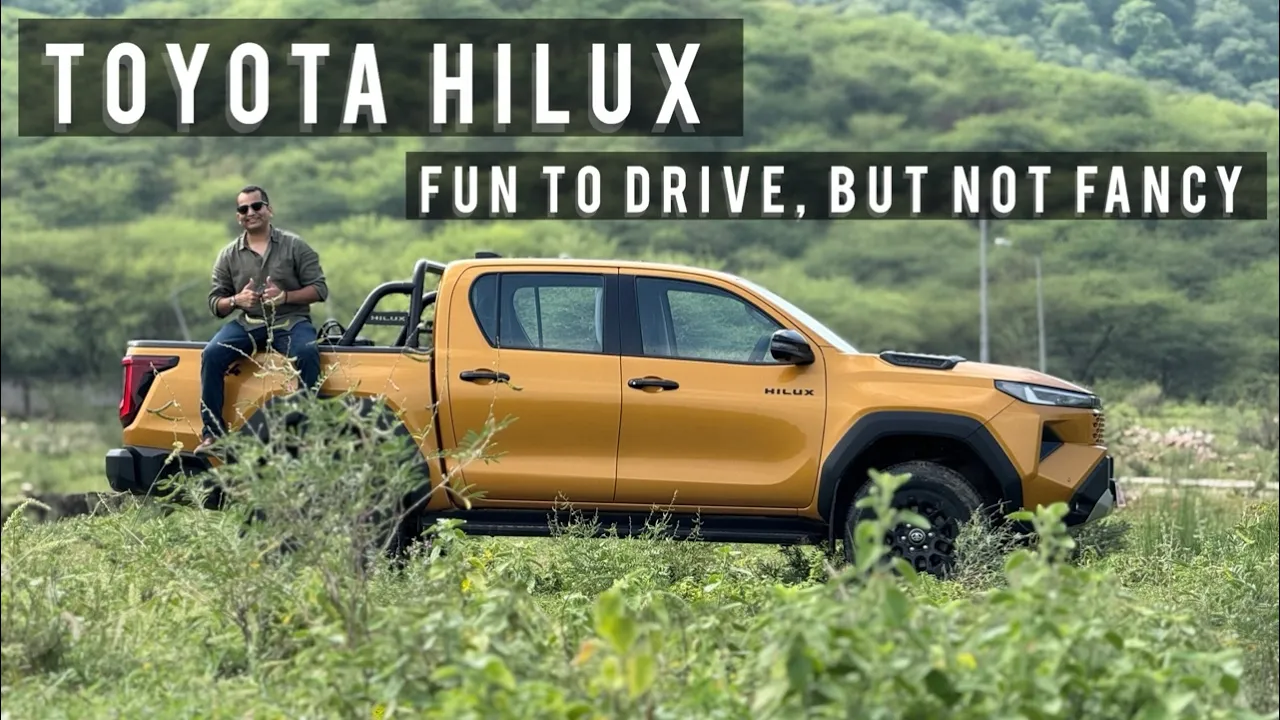
The Toyota Hilux has always been a vehicle that people associate with toughness rather than luxury. It is the sort of pickup that has built its reputation by doing the difficult stuff without making too much of a fuss. With the ninth-generation Hilux, Toyota has moved the needle slightly towards refinement, and after driving it around Jaipur and on the highway, I was genuinely surprised by how civilised this big pickup can feel.
The 2026 Hilux starts at Rs 31.99 lakh ex-showroom and is now available only with a 2.8-litre turbo-diesel and a 6-speed automatic gearbox. There is no manual option, and you don’t get a fancy dual-clutch transmission either. Instead, Toyota has stayed with a conventional torque-converter automatic, which feels entirely appropriate for a vehicle whose priorities are durability, utility and getting the job done.
Refined for a Pickup
The first thing that stood out during the drive was the NVH. The 2.8-litre diesel is remarkably quiet once you are moving, and at around 60-70 kmph, the cabin feels much more refined than you would expect from a body-on-frame pickup truck. There is very little wind noise at these speeds, while the engine itself settles down below 1,500 rpm and becomes barely noticeable.
Even under hard acceleration, the noise-to-performance ratio is impressive. Yes, you can hear the diesel working when you bury the throttle, but it never becomes excessively clattery or unpleasant inside the cabin. Once you lift off, it quickly settles back into its quiet state, giving the Hilux a level of refinement that is almost luxury-like when viewed through the lens of what this vehicle is actually designed to do.
That doesn’t mean Toyota has turned the Hilux into a plush SUV. It remains a utility-focused machine, but it doesn’t feel like you are driving a commercial pickup with goods in the back.
Steering takes some effort
The biggest adjustment for anyone moving from a modern SUV into the Hilux is likely to be the steering. Toyota continues with hydraulic assistance here, and that gives it a more mechanical feel than the light EPS systems found in most modern cars.
At parking and city speeds, however, that comes with a clear downside. Making tight U-turns or three-point turns requires genuine effort, and you need both hands when you are working the wheel from lock to lock. It isn’t unmanageable, but it certainly isn’t effortless, and elderly drivers or someone unfamiliar with large vehicles may initially find it heavy.
Thankfully, once the Hilux starts moving, the steering becomes much easier to live with. At highway speeds, it feels natural and predictable, with enough feedback to give you a good idea of where the front wheels are pointing. There is some body roll and pitch, as you would expect from a large body-on-frame vehicle, but the steering never makes you feel disconnected from what the truck is doing.
Driving ease
Visibility is another area where the Hilux does a good job. The commanding driving position gives you an excellent view over the bonnet, while the large wing mirrors and decent glass area make it easier to understand where the four corners of the vehicle are.
At 5ft 8in, even at the lowest seat setting, there is plenty of headroom and a very commanding view forward. The mirrors also give you a good indication of the edges of the load bed, which becomes particularly useful while reversing or manoeuvring in tight spaces.
The ergonomics are straightforward as well. Most controls fall naturally to hand, and there isn’t much of a learning curve involved. The problem is that for a vehicle costing upwards of Rs 30 lakh, the cabin can feel rather basic.
Toyota has clearly prioritised utility over showmanship. There is no panoramic sunroof, no automatic climate control and no leather upholstery even in the higher trims, while the touchscreen infotainment and camera quality feel average for a vehicle in this price bracket. The cabin gets the basics right, but buyers expecting a premium SUV experience at this price may feel short-changed.
Performance
The 2.8-litre turbo-diesel makes 204 PS and 500 Nm, and that is a healthy amount of performance for such a large vehicle. What is particularly impressive is how effortless the Hilux feels when you ask it to accelerate.
Even in Eco mode, the truck builds speed surprisingly quickly, and the strong mid-range torque makes overtaking fairly effortless. Switch to Sport and floor the accelerator, and you realise just how much performance Toyota has managed to extract from this powertrain. A 0-100 kmph run is certainly not sports-car quick, but for something this large and heavy, the acceleration is more than respectable.
The 6-speed torque-converter automatic isn’t particularly flashy, but it suits the vehicle. Gearshifts are smooth and unobtrusive during normal driving, while Sport mode allows you to use the Tiptronic function and hold a particular gear when required.
Ride quality
The Hilux’s ride quality is better than its construction might suggest, although you need to understand what kind of vehicle this is. It remains a body-on-frame pickup, so there is some movement through the cabin, particularly over rough surfaces. You can feel the axles, suspension and body working underneath you, and the vehicle is never completely flat or settled in the way a monocoque SUV would be.
The important part is that those movements don’t translate into harsh impacts. Over broken roads, the suspension absorbs bumps reasonably well, and while you can see and feel the vehicle moving, the occupants aren’t constantly being thrown around.
The seats deserve plenty of credit here because they are well cushioned and supportive. There is no electric adjustment, but the seat itself is large enough to accommodate a wide range of body types, and the padding provides good support over longer journeys.
Stability
Where the Hilux really surprised me was on the highway. At triple-digit speeds, the truck remains remarkably stable, and the suspension doesn’t allow excessive vertical movement or bounce. Even around 130-140 kmph, it feels composed, provided you remember that you are driving a large pickup rather than a sports SUV.
Fast lane changes are also handled better than expected. The body rolls, naturally, but the movement is controlled and the truck remains predictable. A sudden steering input won’t instantly make you question your life choices, which is reassuring considering its size and proportions.
Off-Road capability
The Hilux also retains the capability that has made its name so respected. During a short off-road drive, the stock tyres provided impressive grip over loose surfaces, steep inclines and descents, as well as through uneven terrain and articulation sections.
With four-wheel drive and the available low-range gearing, the Hilux doesn’t require you to be an expert to make progress. The vehicle is capable enough to manage difficult sections without constantly demanding perfect throttle modulation or elaborate steering inputs.
Final thoughts
The Hilux is proof that you don’t always need a long equipment list to make a vehicle feel special. Yes, I would have liked better infotainment, automatic climate control and a few more premium touches at this price, but after spending time behind the wheel, those shortcomings become easier to overlook. What remains is a big, immensely capable pickup with a refined diesel engine, reassuring highway manners and enough performance to make you forget just how large it really is.
Also read: Nissan Gravite Review: The Most Affordable 7-Seater

