

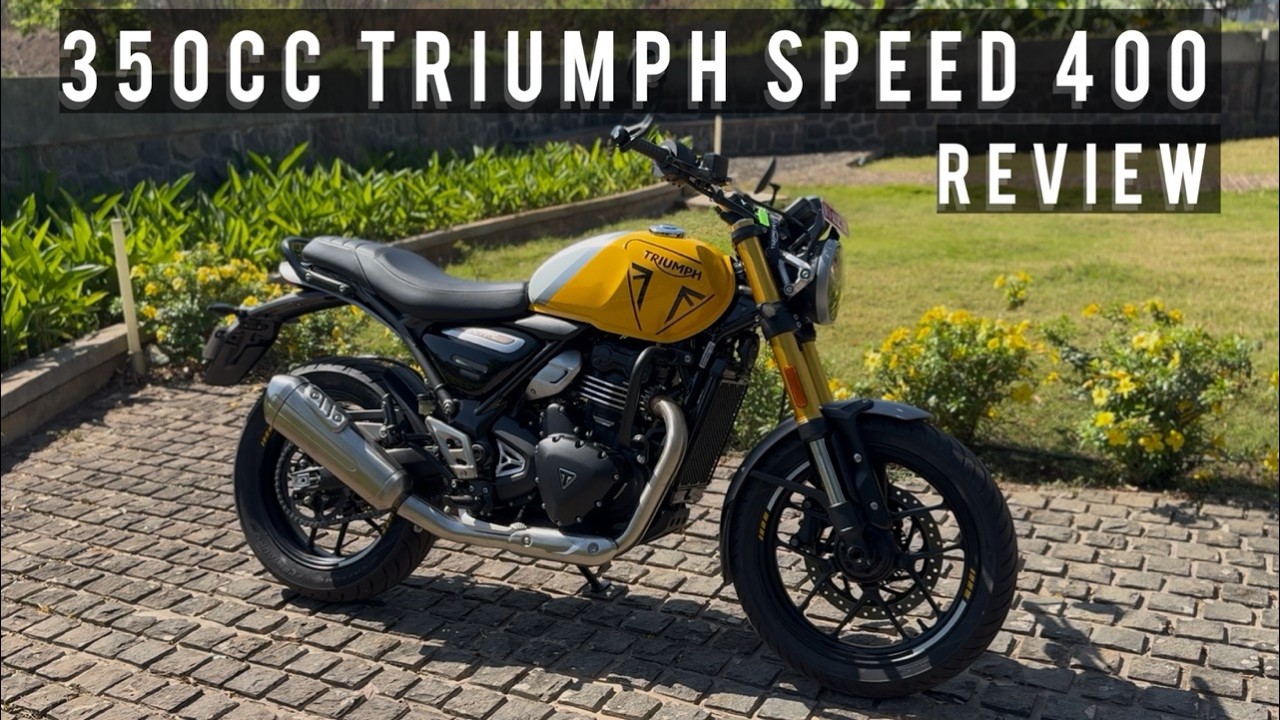
The biggest talking point around the updated Triumph Speed 400 is not something you can immediately see because visually, this motorcycle remains exactly the same as before. Park the new version beside the outgoing model and unless someone specifically points out the revised engine badging, you would struggle to tell them apart.
The colours remain unchanged, the wheels are identical, the tyres continue as before and even the suspension setup, weight and overall proportions remain more or less untouched. That is because Triumph has approached this update differently. Instead of redesigning a successful product, the company has focused purely on revising what sits underneath.
This is still called the Speed 400 despite now using a smaller 349cc engine and the logic behind that is fairly straightforward. Automotive brands globally have followed similar strategies for years where model names eventually become stronger than engine displacement itself.
Whether you look at premium performance cars or mainstream products, engine capacities evolve while model names continue because customers associate more with the product identity than the exact cubic capacity figure. Triumph has done precisely that, not just with the Speed 400 but also with the Scrambler range, the Speed T4 and even the newly introduced Tracker 400.
What makes this update particularly important for Indian buyers is the impact on pricing because while ex-showroom figures might not dramatically alter buying decisions, the reduction in on-road pricing thanks to GST revisions certainly does. Savings stretching close to Rs 21,000 to Rs 22,000 can make a meaningful difference when purchasing a premium motorcycle and that immediately raises an important question, have buyers actually lost something significant in return?
What Has Changed Underneath?
Mechanically, the changes are substantial even though the motorcycle does not feel dramatically different. The Speed 400 now uses a 349cc liquid-cooled single-cylinder engine producing 37PS and 32Nm compared to the earlier motor which produced 40PS and 37.5Nm. Naturally, performance figures have shifted slightly too, with 0-100 km/h now taking 8.1 seconds instead of 7.4 seconds while top speed drops marginally as well.
However, Triumph hasn’t simply reduced displacement and walked away. The company has shortened the stroke, reworked the crankshaft, optimized crank and rotor inertia, revised the air intake system, altered valve timings and redesigned the combustion chamber while maintaining the same compression ratio. The throttle maps have become more aggressive to compensate for the reduced displacement while refinement improvements have also been carried out through changes to the balancer system.
Interestingly, almost everything surrounding this engine remains untouched. The chassis continues as before, sprocket sizes remain identical, suspension tuning is unchanged and even the overall weight remains largely similar. What Triumph and Bajaj appear to have done here is preserve everything customers already liked while modifying only the engine to suit the revised taxation structure.
The Speed 400 Still Feels Incredibly Easy
Throw a leg over the motorcycle and the first thing that stands out is how approachable it continues to feel. At 5’8”, the riding position immediately feels natural and welcoming because nothing about this motorcycle tries too hard to intimidate you. The handlebar placement feels comfortable, the footpeg positioning introduces a slightly sporty flavour without becoming aggressive and the motorcycle itself feels surprisingly light once moving.
This ease of use has always been one of the Speed 400’s biggest strengths because it never demands effort from its rider. Whether you are weaving through traffic, changing directions quickly or simply maneuvering through crowded parking spaces, the motorcycle responds without requiring much physical input from you. That makes it equally suitable for someone upgrading from smaller motorcycles as well as someone purchasing their first premium motorcycle altogether.
More importantly, the motorcycle remains comfortable over longer durations because the rider triangle simply works. You sit slightly leaned forward but never aggressively so, which means city commuting feels relaxed while longer highway journeys still keep you engaged enough to enjoy the ride.
Does The Smaller Engine Actually Feel Smaller?
This is probably where most potential buyers will focus their attention and surprisingly, the answer is not as straightforward as the specification sheet suggests.
Around the city, the revised engine feels remarkably familiar. The exhaust note retains that characteristic Triumph personality while the engine itself continues delivering power in a smooth, linear and predictable manner. At lower speeds, refinement remains impressive because vibrations are minimal through the handlebars and footpegs while the mirrors stay reasonably stable even when revving harder.
Push the motorcycle closer towards higher RPMs and yes, some buzz begins appearing beyond approximately 7,000 RPM, but it never becomes intrusive enough to ruin the experience. Even at highway speeds above 100 km/h, what reaches the rider is more of a mild reminder that you are riding a single-cylinder motorcycle rather than something genuinely uncomfortable.
The reality is that most owners rarely spend their daily commutes chasing maximum horsepower figures. Riding inside cities such as Pune, Mumbai or Bengaluru rarely gives riders enough opportunities to fully exploit peak power outputs and because of that, the difference between the outgoing motorcycle and this revised version feels surprisingly small during regular usage.
Engine And Gearbox
What immediately stands out while riding is how tractable this motorcycle continues to feel. Pulling away from a standstill requires almost no effort and even rolling forward on inclines happens without drama. The clutch remains extremely light, the gearbox continues shifting with precision and the motorcycle feels effortless during repeated gear changes in traffic.
This matters far more in ownership than outright acceleration numbers because daily commuting involves crawling traffic, endless gear shifts and repeated stop-go situations. In these conditions, the Speed 400 continues delivering exactly what buyers appreciated before which is simplicity.
Even highway riding remains relaxed because cruising speeds arrive at relatively low RPMs, meaning sustained riding does not leave you feeling fatigued. Whether sitting at 80 km/h or stretching towards triple-digit speeds, the motorcycle feels composed and comfortable enough to handle longer touring duties.
Handling, Braking And Ride Quality
Since Triumph hasn’t touched the chassis or suspension setup, the Speed 400 retains the same likeable handling characteristics. The motorcycle changes directions quickly, feels playful when pushed and yet never sacrifices stability in the process.
The suspension deserves particular appreciation because it continues balancing comfort and sportiness extremely well. Broken roads, expansion joints and uneven surfaces are absorbed without unnecessary movement while spirited riding still feels enjoyable enough to encourage you to push harder.
The Vredestein tyres continue complementing the package nicely too because grip levels remain reassuring whether accelerating aggressively, braking hard or changing directions quickly. Similarly, braking performance remains strong with good bite from both ends while ABS intervention feels well calibrated instead of overly intrusive.
Should You Worry About The Smaller Engine?
The easiest mistake buyers can make is looking purely at engine displacement and assuming this motorcycle has become significantly worse because the riding experience simply doesn’t support that conclusion.
Yes, performance numbers are lower. Yes, power and torque have dropped.
But when viewed as a complete ownership package, the motorcycle still looks premium, still feels refined, still handles beautifully and still delivers an experience that feels larger than the numbers suggest.
Perhaps that is the biggest compliment this update deserves because despite meaningful mechanical revisions underneath, the motorcycle continues feeling unmistakably like a Speed 400.
Also read: Triumph Scrambler 400 XC review

