

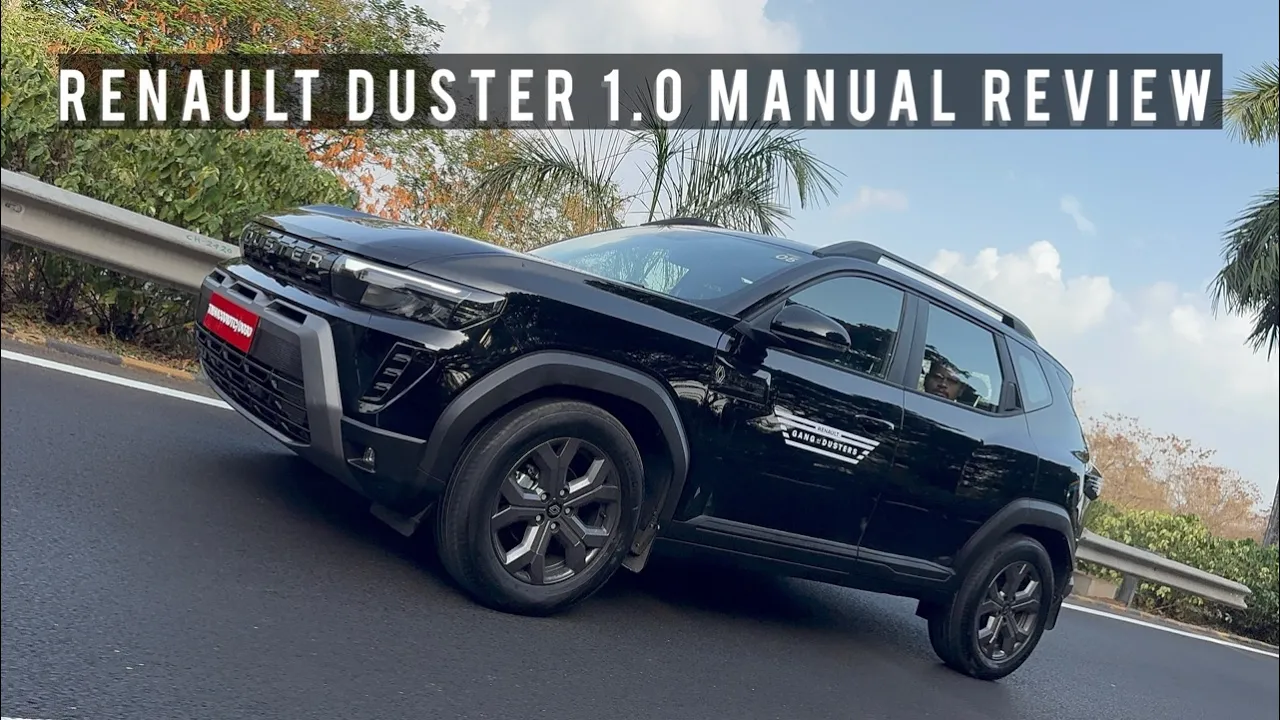
The new Renault Duster has already made a strong impression with its driving dynamics, but the version that surprises the most is not the more powerful or expensive one. It is this entry-level 1.0-litre turbo-petrol manual. With prices starting at Rs 10.49 lakh for the Authentic variant, the 100 PS Duster is the most affordable way to get behind the wheel of the new-generation SUV, and after spending over 130 km with it across city roads, highways and the Lonavala ghats, I came away quite impressed.
Power and performance
On paper, this engine does not sound particularly exciting. It is a 999 cc three-cylinder turbo-petrol motor producing 100 PS and 166 Nm, paired exclusively with a six-speed manual gearbox. There is no automatic option, and this engine is also not available on the higher trims. The Techno variant tested here costs Rs 13.49 lakh, while the Evolution sits at Rs 11.69 lakh, all prices ex-showroom.
The power figure is actually one of the lowest in the segment. The torque figure, however, is where things get interesting. Renault says maximum torque is available from 2,000 rpm and the engine has been calibrated to offer a fairly flat torque delivery. In the real world, that makes a noticeable difference.
The biggest concern before driving this Duster was the three-cylinder engine. Three-cylinder motors can sometimes feel coarse, particularly when you start them, pull away from a standstill or load them heavily. The Duster does have some of that characteristic, but it is far from being objectionable. At idle, there is a mild three-cylinder thrum and some vibration can be felt through the steering wheel and other touch points. It is more noticeable during a cold start and when pulling away in first gear. Once the car starts moving, however, most of that disappears.
At around 70-80 kmph on the Mumbai-Pune Expressway, the engine is surprisingly quiet. At 80 kmph in sixth gear, the engine is sitting at around 2,000 rpm and there is very little engine noise making its way into the cabin. Even under hard acceleration, the engine does not become particularly thrashy or unpleasant. That is important because this is a Duster you could realistically use for long highway drives. The small engine does not constantly remind you that it is a small engine.
Renault claims a 0-100 kmph time is not the headline here, but the way this engine builds speed in the real world is what matters. From a standstill, the Duster gathers momentum in a smooth and predictable manner. There is no sudden turbo kick or aggressive surge, which makes it quite easy to drive in traffic.
Even better is the in-gear acceleration. I deliberately tried overtaking slower-moving vehicles without immediately dropping down a gear, and the engine was able to build speed reasonably well even in sixth gear. The torque delivery is linear, so you do not get a sudden spike in performance. Instead, the Duster steadily gathers pace.
The gearbox
The six-speed manual itself is reasonably easy to use, but it is not perfect. The clutch is light, which is particularly welcome in city traffic, and after driving the car for more than 130 km, there was no fatigue from repeatedly operating it.
The gear throws are also reasonably short, and the transmission slots into the correct gate without any major problems. However, the shift action could have been smoother. There is a slightly mechanical, plasticky feel to the gear changes, and it does not have the slickness you would expect from a gearbox in this price bracket. The gear knob itself also feels a little ordinary. It works perfectly well, but the tactile experience could have been better.
The bigger issue, however, is the absence of an automatic option. Renault offers this 1.0-litre engine only with the six-speed manual, and that limits its appeal in large cities where crawling through traffic is part of everyday life. An AMT or, preferably, a more sophisticated automatic option would make this engine considerably more versatile.
For someone who enjoys driving, though, the manual combination makes sense.
The handling
If there is one reason to consider the new Duster over its rivals, it is the way this SUV handles. The steering is easily one of the highlights of the car. It is light enough at low speeds to make parking and manoeuvring effortless, but it gains weight as the speeds increase. More importantly, it has a surprisingly direct response.
On winding roads, the steering gives you confidence to place the car exactly where you want it. There is not much of that vague, disconnected feeling that you get from some mainstream SUVs. Quick steering inputs are met with a predictable response, and the Duster remains composed when you start driving it harder.
Yes, there is some body movement because this is still a relatively tall and sizeable SUV. You can feel the body roll if you enter a corner aggressively. But it never feels unpredictable, and within sensible limits, the chassis gives you plenty of confidence. This is particularly impressive considering the engine underneath the bonnet is the entry-level unit.
The Duster continues to feel like a driver’s SUV rather than something that has been engineered purely around comfort and equipment. If driving enjoyment is high on your priority list, there isn’t much in this segment that can match it.
The suspension
The suspension is arguably just as impressive as the steering. During the drive, I took the Duster across highways, broken surfaces, poorly levelled roads, potholes, speed breakers and the winding roads around Lonavala. It handled all of them with a level of maturity that you don’t always find in this segment.
The suspension does not feel excessively soft, nor is it stiff. Instead, it manages to absorb broken surfaces without sending sharp thuds into the cabin. Even when the road surface gets particularly bad, the Duster remains composed.
What impressed me more was the way it behaved at higher speeds. Poorly surfaced Indian highways can often leave an SUV constantly moving vertically, but the Duster does not become excessively floaty or unsettled. There is some movement, naturally, but it remains controlled. There is also very little kickback through the steering when you encounter a rough patch.
The Duster does not have an all-wheel-drive system in this generation, but its ground clearance, suspension and overall construction give it enough confidence to deal with rough roads. It feels equally comfortable on a highway, inside the city and on a rough trail.
The brakes
There is one area where I think Renault could have done better: braking performance under hard use. For normal city and highway driving, the brakes are perfectly adequate. The pedal is easy to understand and the initial bite is not excessively sharp, so the vehicle does not constantly nose-dive whenever you touch the pedal.
However, when you need to brake aggressively, particularly when carrying higher speeds into a corner or during an emergency stop, I felt that the braking could have had a little more bite. It is not a situation where the brakes feel unsafe. Rather, the pedal needs a little more effort and travel before you get the kind of stopping power you expect when you’re really asking the car to shed speed quickly.
For normal driving, this isn’t a deal breaker. But given how capable the Duster feels everywhere else, stronger braking performance would have completed the package.
What is the cabin like?
The entry-level engine does mean that you don’t get some of the nicer features available on the more expensive Duster variants. There are no ventilated seats, for example, and the digital driver’s display is smaller. However, the basic functionality is still quite good.
The touchscreen infotainment system worked without any glitches during the drive and offers wireless Apple CarPlay and Android Auto. The physical air-conditioning controls are also easy to operate, while the steering-mounted buttons are large and intuitive.
There is a decent amount of storage and the driving position is comfortable. The front seats provide good support, while the manual gearbox, clutch and pedals are positioned well enough for longer drives.
There is one ergonomic oddity that Renault has carried over: the separate infotainment control stalk behind the steering wheel. Some Renault owners like it, but I still find it unnecessarily complicated when conventional steering-mounted controls have become the norm.
On the positive side, visibility is excellent. The large wing mirrors, good driving position and relatively commanding view make the Duster easy to place on the road.
Real-world fuel efficiency
Renault claims fuel efficiency of around 19.4 kmpl for this engine. During my drive, which included city traffic, the Mumbai-Pune Expressway and the Lonavala ghats, the Duster returned 12.8 kmpl. That is considerably lower than the claimed figure, but it is also a much more useful number for anyone trying to understand what the car might deliver in actual usage.
The test involved highway driving as well as spirited sections and traffic, so owners who drive more gently and spend more time cruising could potentially see a better figure. Still, 12.8 kmpl is a realistic reference point based on this particular drive.
The engine is also E20-compatible and gets an idle start-stop system to help reduce fuel consumption in traffic. The system works as expected, shutting the engine down when the car comes to a standstill and restarting it when you press the clutch.
However, on hot days, there is a trade-off. With the engine switched off, the air-conditioning performance can be affected, which means I would personally prefer to deactivate the system when the weather is particularly hot.
2026 Renault Duster 1.0 Turbo Petrol Manual: Verdict
The entry-level Duster turned out to be a much better car than I expected. I came into this test thinking that a 1.0-litre three-cylinder engine in a midsize SUV would inevitably feel compromised. It doesn’t. The 166 Nm of torque, the calibration of the engine and the relatively linear power delivery make this Duster surprisingly easy and enjoyable to drive. But the real star remains the chassis.
The steering is responsive, the suspension is extremely well judged and the Duster feels planted without becoming uncomfortable. It is one of those SUVs that makes you look forward to driving rather than simply treating the journey as a way of getting from point A to point B.
There are caveats. The gearbox could be smoother, the braking performance under hard use could be stronger and the absence of an automatic option significantly limits the appeal of this engine for buyers dealing with heavy urban traffic. Equipment is also understandably reduced compared with the higher variants.
But if you are someone who prioritises driving dynamics, ride quality, highway comfort and real-world usability over having every possible feature, the 1.0-litre Duster deserves to be on your shortlist.
Also read: 2026 Renault Duster Review

