

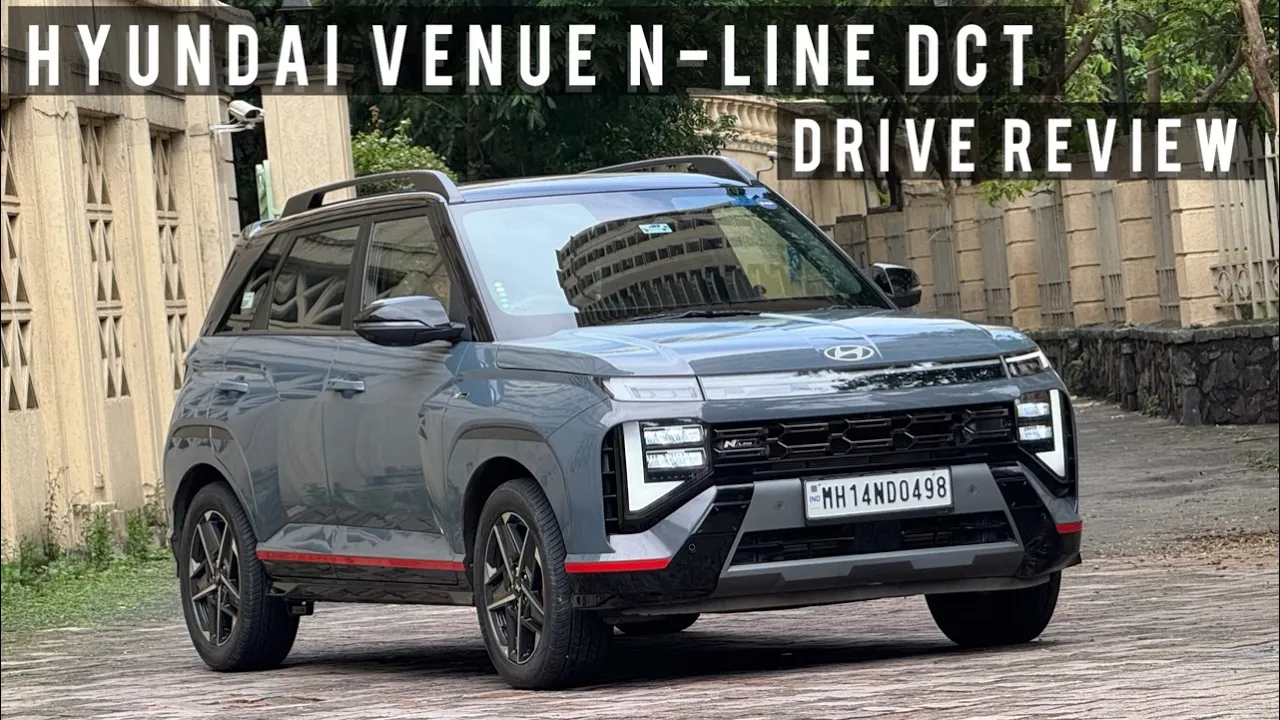
The Hyundai Venue N-Line has always occupied an interesting space in the Venue range. It is still a compact SUV designed to be easy to drive every day, but Hyundai has added enough mechanical and cosmetic changes to give it a more enthusiastic character.
After spending more than 1,150 km with the 1.0-litre turbo-petrol DCT, including heavy Mumbai traffic and a Mumbai-Lonavala run, I found that the N-Line delivers on the sporty part of its brief rather convincingly. The bigger question is whether that sportiness comes at too high a cost when you have to live with the car every day.
The heart of the experience is Hyundai’s 1.0-litre three-cylinder turbo-petrol engine, which produces 120 PS and 172 Nm. It is not an outrageous amount of power, but in a sub-4-metre SUV it is enough to make the Venue N-Line feel properly quick, particularly when paired with the 7-speed DCT. More importantly, Hyundai has given the car some character beyond the numbers, and the first thing you notice is the exhaust.
A three-cylinder that actually sounds good
The specially tuned exhaust system gives the Venue N-Line a deeper, throatier character under acceleration, and it is particularly enjoyable when you start the car or pull out of a covered parking area. You get enough of that rumble to know this isn’t the standard Venue, but it never becomes so loud that it turns into a nuisance for the occupants or everyone around you.
The good thing is that the cabin remains quiet when you aren’t in the mood for spirited driving. At 70-90 kmph, the engine settles down nicely, and the Venue N-Line is quite refined on a well-paved road. Even at around 100 kmph, the cabin doesn’t feel particularly noisy, although some wind buffeting can be noticed at higher speeds in open and windy conditions.
The DCT complements the engine
The 7-speed DCT is easily one of the strongest parts of this package because it manages to remain smooth enough for daily commuting while becoming properly entertaining when you switch to Sport. In normal traffic, the gear changes are well judged and smooth, with very little of the head-nod or jerkiness that can sometimes make dual-clutch gearboxes tiring in congested conditions.
Once you start driving harder, however, the character changes noticeably. Sport mode sharpens the responses and the gearbox shifts rapidly, particularly under full throttle. There is a satisfying surge during upshifts, and the transmission responds quickly when you use the paddle shifters. The Tiptronic function through the gear selector gives you another way of taking control, although the paddles are the more natural choice when you’re really pushing the car.
Three modes
The three drive modes i.e. Eco, Normal and Sport also give the Venue N-Line a noticeable change in character. Eco softens the responses and works well when you’re simply commuting, while Normal provides the balance most people will probably use most of the time. Sport sharpens the throttle, changes the gearbox calibration and adds more heft to the steering, making the car feel much more eager.
There are also Snow, Mud and Sand traction modes, although these are more of a useful backup than something you are likely to use regularly. They can help when you find yourself on loose or slippery surfaces, but for most owners they will spend the majority of their lives untouched.
Handling
The steering is light enough to make the Venue easy to manoeuvre around town, but it isn’t excessively vague. There is some dead play around the centre, so it isn’t the most communicative steering system for an enthusiast, but the response is direct enough to give you confidence. The steering wheel itself deserves credit for being one of the nicest parts of the cabin, with a good size, useful thumb contours and a sporty N-Line design that feels good in your hands.
Where the Venue N-Line really shines is when the road starts getting interesting. The stiff setup and relatively compact dimensions give the car very good body control, so quick lane changes and sweeping corners at highway speeds feel reassuringly stable. There isn’t much pitching or rolling, and the car remains predictable even when you’re carrying speed into a bend. The all-disc braking setup complements that behaviour well, with enough bite and good pedal confidence without making the car feel nervous.
Ride quality
The Venue N-Line rides on 17-inch wheels, and the suspension has clearly been tuned with handling in mind. On a smooth road, this works brilliantly because the car feels tight and controlled with very little unwanted movement. Unfortunately, Indian roads are rarely smooth for long, and the Venue N-Line can become uncomfortably sharp when the surface deteriorates.
Potholes, broken patches and sharp-edged imperfections make their presence felt inside the cabin, and I initially suspected that the tyres might have been overinflated. After experimenting with tyre pressures, it became clear that the suspension itself is the bigger reason. It is simply stiff, and there isn’t much variation between low-speed urban driving and faster highway work.
Fuel economy
The other issue becomes obvious when you look at the fuel-efficiency figures over a longer period. After more than 1,150 km of driving, including heavy Mumbai traffic, more than 48 hours in the car and a Mumbai-Lonavala road trip, the overall figure stood at 9.7 kmpl. A particularly congested day brought the number down to 8.9 kmpl, while a shorter drive involving several acceleration runs returned 11.2 kmpl.
That doesn’t mean the Venue N-Line cannot be efficient. On an open highway with steady speeds and a restrained right foot, 15 kmpl or more should be achievable. But if most of your driving is in urban traffic and you regularly exploit the turbo engine’s performance, single-digit efficiency is something you will have to accept.
Final Thoughts
The Venue N-Line is a little contradictory, and that is precisely what makes it interesting. It is comfortable enough to use every day in terms of its gearbox, steering and cabin refinement, but its suspension constantly reminds you that Hyundai wanted this version to be sporty. On a smooth road, that decision pays off with excellent control and a genuinely enjoyable drive; on a broken one, you start wondering whether a little less enthusiasm from the suspension would actually make the car better.
Also read: 2026 Skoda Kushaq Facelift Review

