

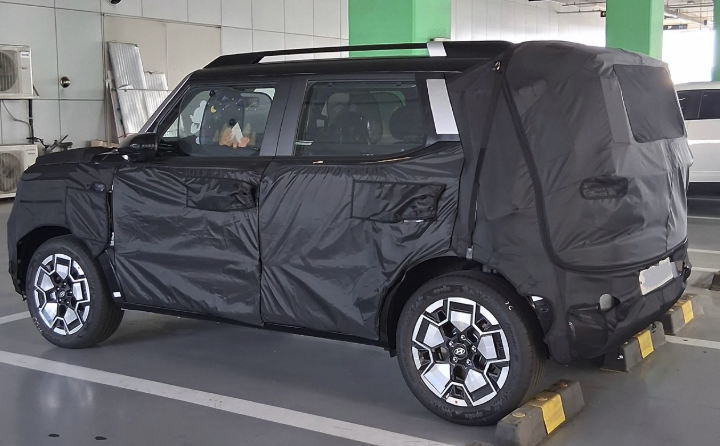
Key highlights
- Hyundai’s new compact electric SUV, codenamed HE1i, will debut in India by the end of 2026.
- It will be built in India on the E-GMP (K) platform and offered in Standard Range and Long Range versions.
- The EV will initially use Svolt battery cells, before Hyundai plans to shift to locally sourced cells from Exide.
Hyundai is bringing its most important mass-market EV yet to India, and it is coming sooner than expected. The company’s new compact electric SUV, internally codenamed HE1i, is now confirmed to debut by the end of 2026. Hyundai had previously indicated that the model could arrive by March 2027, but Hyundai Motor India CEO Tarun Garg has now confirmed an earlier timeline.
Change in lauch timeline
The new EV will be designed and manufactured in India and will use Hyundai’s E-GMP (K) platform, which also underpins the Inster EV sold in international markets. The India-specific model is expected to sit in the compact SUV segment and take on established players such as the Tata Nexon EV, along with upcoming electric models including the Mahindra XUV 3XO EV and Kia Syros EV.
One interesting development concerns its battery supply. Hyundai had originally planned to use locally produced cells from Exide, but production delays at Exide have forced a temporary change in strategy. The HE1i will therefore initially use Svolt-supplied battery cells. Hyundai still intends to transition to locally produced cells through its partnership with Exide once they become available.
What to expect
The compact EV will be offered in Standard Range and Long Range versions, although Hyundai has not revealed battery capacities or range figures yet. For reference, the international Inster gets 42 kWh and 49 kWh battery options, with claimed WLTP ranges of up to 300 km and 355 km respectively. These figures should not be assumed for the India-spec model.
Hyundai has also confirmed a next-generation infotainment system and Level 2 assisted driving technology. The car will be manufactured at Hyundai’s Sriperumbudur facility in Tamil Nadu.
Hyundai expects EVs to account for more than 7 percent of its domestic sales within the next year, compared with around 1 percent in FY2026. The HE1i will be central to that push because it takes Hyundai into a much more accessible part of the EV market.
Also read: Hyundai Bayon-based SUV new spy shots reveal its design

